New York’s brick buildings are a defining feature of the city. Brownstones in Brooklyn, pre-war apartments in Manhattan: they are steeped in history. But even the most durable brickwork starts to age.
Restoration is more than just giving a building a makeover. It’s about restoring it in a way that allows it to maintain its strength, utility, and value in a city that is putting a lot of wear and tear on its buildings.
Quick Answer
The restoration of old brick buildings in New York City requires an assessment of the building, repair of or replacement of bricks, repointing of mortar, control of moisture and maintenance of the architectural integrity. This is a mix of structural and historical preservation.
Where the Process Begins
Restorations typically don’t begin with extensive repairs. They start with subtle indicators, which become more pronounced over time.
You may see mortar joints begin to pull away, or begin to see small cracks in certain parts of the wall. It could be a change in colour, or sections of wall that seem to retain moisture longer.
At this point, the building is already speaking to you. What you have to determine is whether it’s surface wear and tear or something more serious.
The first step in a restoration is to inspect the surface: not only what’s there, but also what it might be hiding.
Assessing the Condition of the Brickwork
The first step of any restoration is to assess the brick and mortar together.
In many historic buildings in NYC the mortar is softer than the brick. This can give the building some degree of flexibility. However, as the mortar deteriorates, it exposes the bricks.
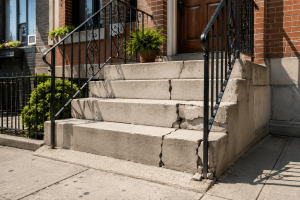
You might notice areas where the mortar joints between bricks have eroded, or where bricks are slightly loose. Sometimes past repairs have been executed with inappropriate materials, which can hasten deterioration.
This is more about understanding than repair. If this is done correctly, the restoration will be successful.
The Role of Repointing
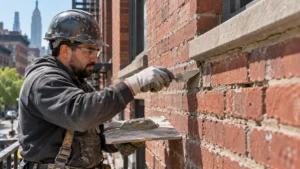
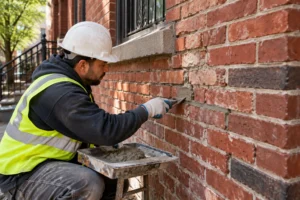
Repointing is a common element in brick restoration. It is the removal of old deteriorated mortar between bricks and replacing that with new mortar that resembles the original.
When done right, repointing reinforces the wall and keeps out water. But it’s not just an engineering job, it’s an aesthetic one.
In New York, particularly in historic districts, mortar color and texture count. If a repair stands out visually, it can be jarring to the overall look.
So it’s important to match and apply new bricks properly.
Repairing and Replacing Damaged Bricks
Some bricks just can’t be saved. They might be too damaged, too worn, or too water-damaged to keep in place.
In these cases, bricks are individually replaced with new bricks that are an exact match in size, shape, colour and texture. This is often more complex than it may seem, particularly in historic structures where it can be difficult to find materials that match older ones.
The idea isn’t to make the building look brand new. It is to make it look natural and not stand out.
Dealing with Water and Other Problems
Brick is strong, but not waterproof. The signs of deterioration in historic buildings are often a result of water getting into the wrong places.
When renovating, consideration is given to water movement. This may mean filling in holes, or installing or fixing points where water drains away.
Without addressing water problems, surface repairs won’t stick. Problems will reappear, and often worse than before.
So, restoration is not only about repair, it is also about prevention.
Preserving the Original Character
Perhaps the hardest thing about renovating old brick buildings in New York is preserving their character.
These buildings shouldn’t look brand new. They have irregularities, imperfections, and patina.
Too much restoration is as bad as too little. New materials that don’t match or finishes that change the texture or colour of the building can be destructive.
The right restoration acknowledges the age of the building while also ensuring its structural integrity.
The Challenges of NYC
New York has its own challenges for restoration. Buildings are often non-detached, access can be difficult, and work can be subject to strict regulations (particularly in landmarked areas).
There’s also the code of ongoing wear and tear. The elements, pollutants and other urban stresses all play their part.
As a result, restoration in this urban environment can be more complex than in other settings. Every action must not only take into account the building, but its environment.
When to Consider Restoration
Restoration doesn’t always take place after damage becomes visible. In fact, often it’s better to intervene when damage is still relatively minor.
When the mortar joints are pulled away, the bricks feel unstable or the wall is uneven or worn, it is often an indication that restoration is needed.
If we delay action, we can end up with a larger and more costly restoration.
If you’re starting to notice these early signs on your building, it’s worth taking a closer look now rather than waiting for the damage to become obvious. NY Concrete can help you understand exactly what’s happening with your brickwork and guide you on the right steps to restore it properly, before it turns into a bigger, more expensive issue.