If your concrete driveway is cracked, leveled-off in some places, or has begun to feel uneven under your feet or the tires on your car, it is likely far more than a surface problem. That’s more than just what you see on the surface; in most NYC residential properties, particularly in areas such as Queens or parts of Brooklyn, these problems tend to originate under the concrete.
It may start with a small crack along the garage or a slight hill where water accumulates after a rain storm. Initially, it doesn’t appear to be urgent. However, over time, these little cracks expand into larger cracks, sunken areas, or edges that begin to separate.
Quick Answer
Typically, concrete driveways crack and sink due to water, weakened or shifting base below. Some surface cracks may be repaired; however, if there is continuing movement, drainage issues, or structural problems, a more comprehensive repair may be required to ensure the damage does not reoccur.
Easy to Spot Signs of Driveway Damage
Most homeowners are not aware of the problem initially. It typically begins in a seemingly insignificant manner. A thin crack develops in one section. Slight chipping occurs at the edge near the curb. Perhaps the water does not flow away from some areas.
Those signs become more apparent over time. Cracks open or get larger in the slab. A driveway section could be slightly lower than the rest. While coming to a stop, you may experience a dip in your vehicle, or water will always collect in the same spot.
At times, the sides droop or fall apart, particularly by the edges which are less supported. This does not just happen at random; it is often a sign of something deeper going on below the surface.
What Is Actually Causing the Cracking or Sinking?
Once the cracks or the sinking becomes noticeable, the next step is to determine what is actually occurring.
While concrete is strong, it is very dependent on the foundation under it. When that base moves, weakens, or washes away, the slab on top will begin to move.
The most frequent cause is soil settlement. As time passes, the soil under the driveway can shrink or shift, particularly if it was not adequately prepared when it was built. In those instances, the concrete is no longer supported and starts to sink in some spots.
Another significant factor is water. When there’s poor drainage, water can get under the slab and slowly wash away the base. During NYC winters, it turns to ice and helps to raise the concrete, and then it drops back down when it melts. This repeated motion is a key reason behind cracking.
Frequent vehicle weight in some driveways, particularly near the garage or curb, puts additional stress on already weak areas. Those areas begin to suffer damage over time.
Why Cracks Near the Garage or Curb Are So Common
Cracks near the garage or curb are common for a number of reasons.
When the driveway is cracking at the point where it meets the garage, you are not the only one. That is the place where the weight gets applied most of the time and is also where water can pool if the slope is not correct.
The edges closer to the curb are less supported. This makes them more prone to decay or movement, particularly if water is infiltrating beneath or if the base was not properly compacted.
These patterns are not coincidental; they typically provide a clear indication of where the pressure or weakness is.
What the Crack Pattern Is Trying to Tell You
People don’t realize that not all cracks are created equal.
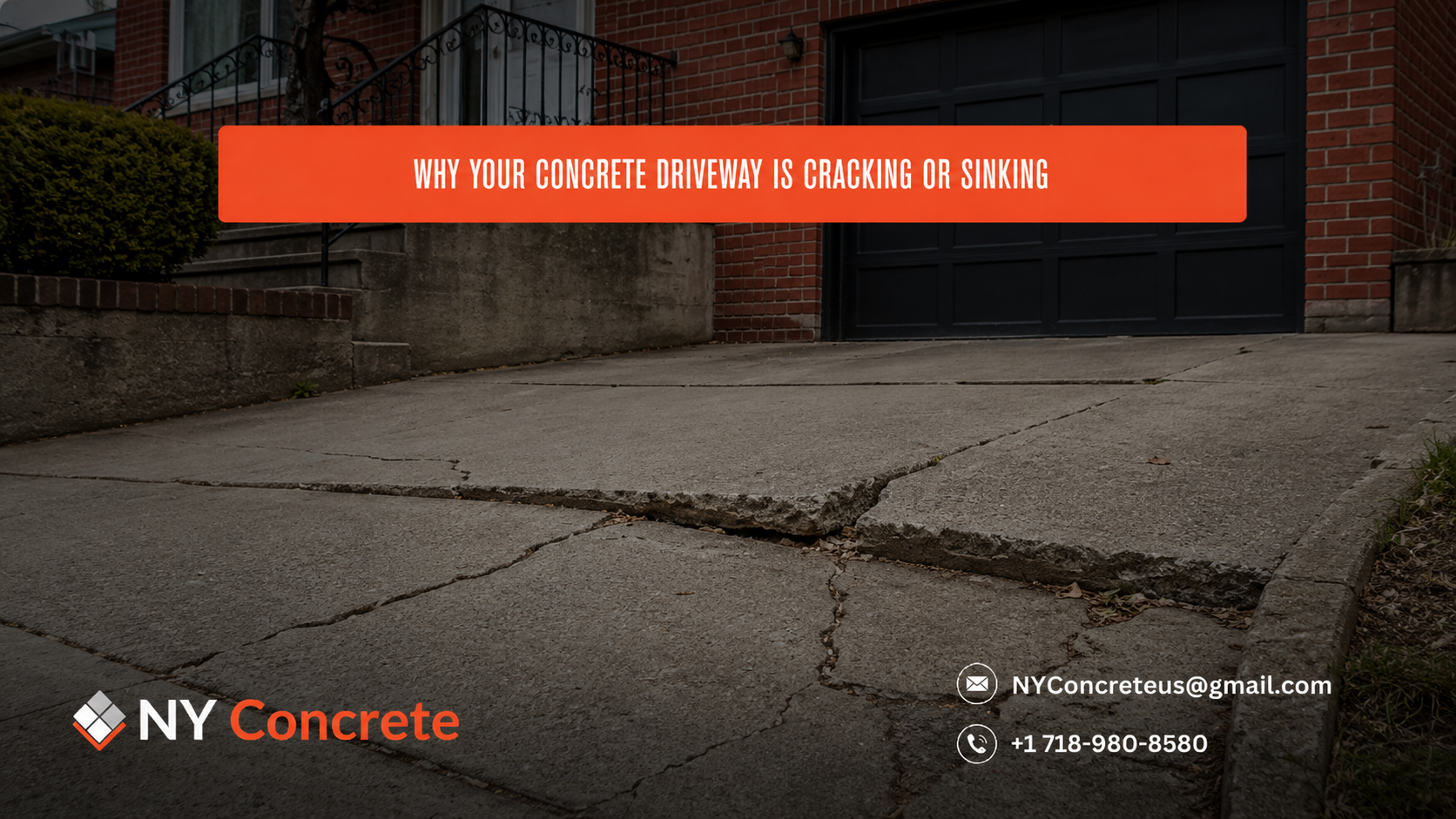
An elongated and straight crack in the slab may indicate movement below the slab, where the concrete is fractured as a single unit. If the cracks are smaller and more spread out, they could indicate surface stress or early-stage wear. If one section is lower, it is typically an indicator of settlement or loss of support beneath it.
Rubbery or broken edges are usually a sign of improper siding. When water accumulates in any particular spot over time, it is likely that the slope is not directing water away as it should.
Correctly interpreting these patterns is the key to understanding whether a simple fix can be made or if there is a deeper problem.
Repair or Replacement: What Does Your Driveway Actually Need?
This largely depends on what is happening beneath the surface.
For minor damage, when there is still stability in the base, repairs such as filling cracks or surface patching may be sufficient to restore the driveway. However, if the concrete is settling, moving, or showing multiple problem areas, the issue is likely deeper than it appears.
In those cases, it is not uncommon for the same problems to return if repairs are attempted without addressing the base and drainage. Sometimes, partial or complete replacement is the better long-term solution, particularly when the structural integrity of the driveway has been affected.
Common Mistakes That Make Driveway Problems Worse
One major mistake is treating all cracks as surface-level issues. Cracks do not appear without a cause, and filling them without understanding the reason often leads to repeated failure.
Another frequent issue is ignoring drainage. Even a well-done repair will not hold up if water continues to collect under or around the driveway.
Many homeowners also delay taking action because the damage appears minor at first. By the time it becomes more visible, the repair process is often more extensive and costly.
NYC Context: Why This Happens So Often
In New York City, driveway damage is rarely just about age. The combination of freeze-thaw cycles, heavy rainfall, tightly packed properties, and older construction methods makes driveways more vulnerable to base movement and water-related issues.
In areas like Queens and Brooklyn, where many driveways were installed decades ago, base preparation and drainage were not always built to handle current conditions. Over time, that shows up as cracking, sinking, and uneven surfaces that gradually worsen if left unaddressed.
Concusion
If your driveway is starting to crack, sink, or feel uneven, the most important step is understanding what is happening beneath the surface before the damage spreads further.
At NY Concrete, we take a close look at the condition of your driveway, the stability of the base, and how water is moving through the area to determine the right solution, whether that means a targeted repair or a full replacement.
If you are noticing early signs or already dealing with visible damage, now is the time to act before the problem becomes more extensive.
Contact NY Concrete today to schedule an inspection and get a clear, honest assessment of what your driveway actually needs.