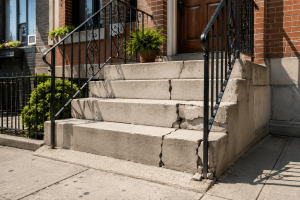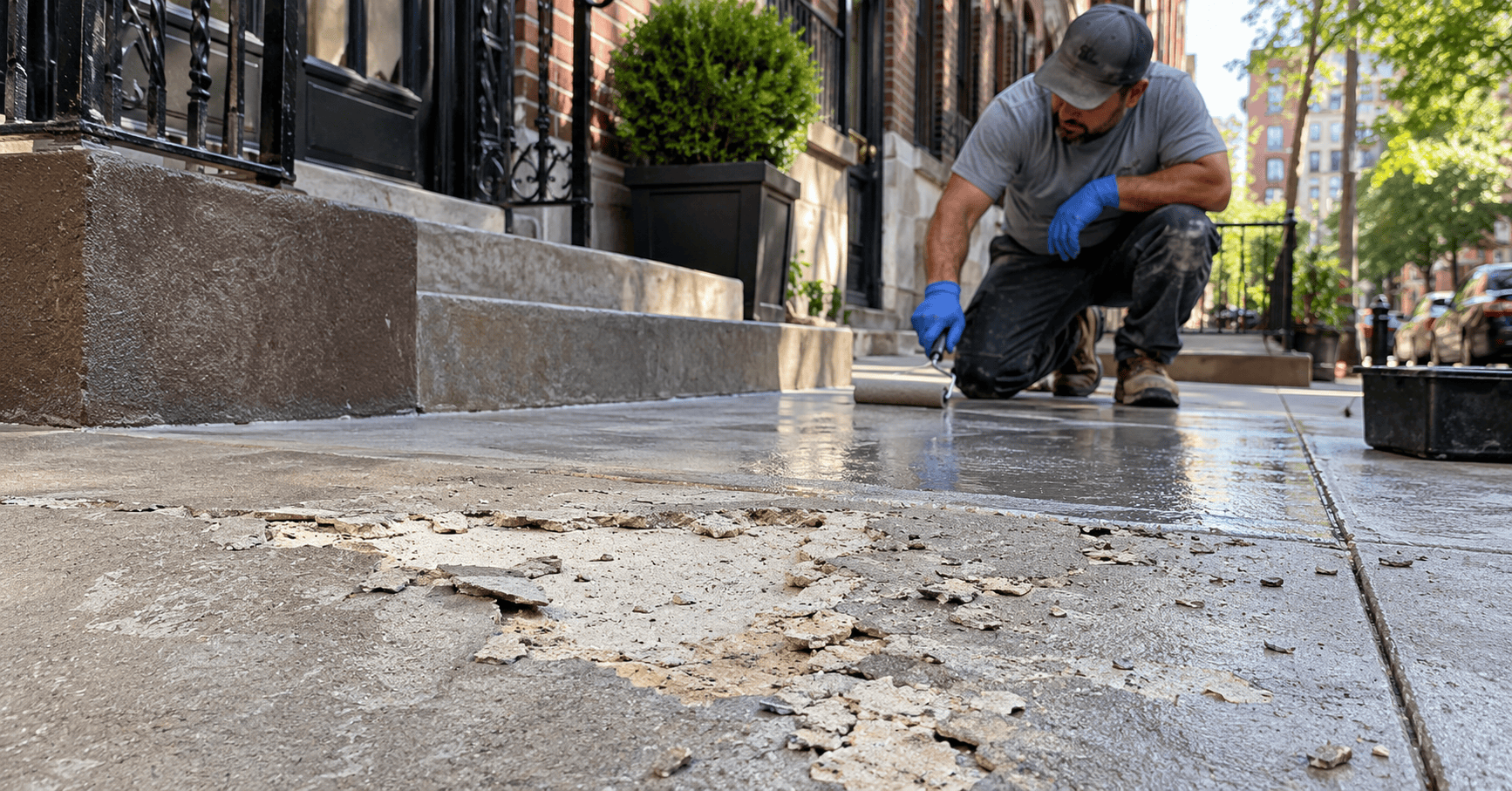
Sweep a concrete driveway or set of steps at the end of winter, and you may find the broom collecting grit, thin pieces of concrete, and small chips that were not there in the fall. The surface looks rough in patches, and in some places, the aggregate underneath is showing.
Concrete that flakes is not necessarily wearing out evenly. It is losing its top layer where moisture, deicing salts, weak surface paste, or finishing problems have contributed to deterioration. Understanding the cause helps determine whether the damage is superficial or a sign of a deeper problem.
What You’re Seeing
Before getting into causes, it helps to understand what the concrete surface is showing. These observations cannot replace an inspection, but they can point toward the underlying problem.
Fine, sandy loss across a broad area: The top cement paste may be scaling away, often associated with freeze-thaw exposure, deicing salts, or a weak surface.
Thin sheets peeling off in one section: The surface may have been finished while bleed water was still present, creating a weak layer that eventually separates.
Small cone-shaped pits: These may be popouts, where a susceptible aggregate particle near the surface expands or fractures and dislodges the concrete above it.
Larger chips with rust stains: Reinforcement near the surface may be corroding, causing the surrounding concrete to crack and break away.
A hollow sound when the surface is tapped: This can indicate delamination, where a layer of concrete has separated from the material beneath it. Professional sounding methods can help identify suspect areas.
Flaking concentrated where water collects: Drainage and repeated saturation deserve investigation.
Different symptoms can point to different causes, which is why identifying the damage correctly matters before selecting a repair method.
What Is Happening Inside the Concrete?
Concrete looks solid, but it contains microscopic pores and capillaries that can absorb and transport moisture.
That becomes a problem when concrete approaches a critical level of saturation and experiences repeated freezing and thawing.
Water expands by approximately 9% when it freezes. However, concrete damage is not caused simply by ice expanding inside every pore. As ice forms, it can create hydraulic and other internal pressures that force unfrozen water through the pore structure.
When the concrete does not have adequate space to accommodate those pressures, microscopic cracks can develop in the cement paste.
Repeated freeze-thaw exposure can progressively weaken the material near the surface.
The deterioration often follows this sequence:
- Moisture enters the concrete through pores, joints, or existing cracks.
- The concrete becomes sufficiently saturated.
- Freezing produces internal pressure within the pore structure.
- Microscopic cracking develops when the concrete cannot adequately relieve that pressure.
- Additional moisture enters damaged areas.
- Repeated freezing and thawing gradually weakens the surface.
- The surface paste begins scaling or flaking away.
Properly air-entrained concrete is more resistant because its microscopic air-void system provides space that helps relieve freezing-related pressure.
Why Deicing Salts Make the Problem Worse
Deicing salts can increase the risk of surface scaling, particularly when concrete is frequently exposed to moisture and freeze-thaw conditions.
Salts alter freezing behavior and can contribute to damaging moisture and temperature conditions near the surface. Certain deicing chemicals can also react with cement-based materials.
This helps explain why concrete deterioration is sometimes more noticeable near driveways, entrances, steps, and other areas where deicers are frequently applied.
However, salt exposure alone does not establish the cause. Concrete quality, curing, drainage, and environmental conditions also matter.
Why Some Concrete Flakes and Some Doesn’t
Two concrete slabs in the same neighborhood can experience similar winter conditions but deteriorate at very different rates.
The difference often comes down to how the concrete was designed, placed, finished, and cured.
Air Entrainment
Concrete exposed to freezing conditions commonly requires an appropriate air-entrainment system.
Air-entraining admixtures create microscopic air bubbles throughout the cement paste. These provide relief spaces that improve resistance to freezing-related damage.
Concrete with insufficient or poorly distributed entrained air may be more vulnerable to scaling when exposed to repeated freeze-thaw cycles.
Too Much Water in the Mix
Adding excessive water can make fresh concrete easier to place, but it also increases the water-to-cementitious-materials ratio.
As the concrete hardens, excess mixing water can leave a more porous cement paste.
A highly porous surface can absorb more moisture and may have lower strength and durability, increasing its susceptibility to deterioration.
Finishing at the Wrong Time
Fresh concrete can release bleed water as its solid particles settle.
If workers finish the surface before that water has sufficiently dissipated, the water may become incorporated into the upper layer.
This can create a weak surface that looks acceptable initially but later begins dusting, peeling, or scaling.
Finishing methods also matter. Excessive manipulation or inappropriate finishing practices can reduce surface durability.
Inadequate Curing
Concrete gains strength through cement hydration, which requires suitable moisture and temperature conditions.
If newly placed concrete loses moisture too quickly or is exposed to freezing before developing adequate strength, its durability can suffer.
Proper curing helps develop a stronger, more durable surface.
Reinforcement Too Close to the Surface
Steel reinforcement can corrode when moisture and chlorides reach it.
Corrosion products occupy more volume than the original steel, generating pressure against the surrounding concrete.
This can cause cracking and spalling, particularly where reinforcement has inadequate concrete cover.
Unlike ordinary surface scaling, corrosion-related spalling may require repairs that address the affected reinforcement.
How Concrete Flaking Severity Is Evaluated
The important question is not simply whether the concrete is flaking. It is how deep the deterioration extends and what caused it.
A contractor may evaluate several conditions.
Depth of damage: Is only the thin surface paste deteriorating, or is the concrete breaking away below the exposed aggregate?
Extent of damage: Is the problem limited to a small section, or does it affect most of the slab?
Soundness of the remaining concrete: Are there hollow-sounding or delaminated areas that suggest the damage extends beyond what is visible?
Moisture exposure: Does water collect on the surface, flow from downspouts, or enter through nearby cracks and joints?
Evidence of reinforcement corrosion: Are there rust stains, exposed steel, or cracking patterns consistent with corrosion?
Condition of the slab: Is the concrete otherwise stable, or are there signs of settlement, movement, or extensive cracking?
Light scaling on an otherwise sound driveway is very different from deep spalling over corroded reinforcement.
That distinction determines whether surface treatment, localized repair, resurfacing, or replacement is appropriate.
What the Realistic Repair Options Look Like
The repair method should follow the diagnosis, not just the appearance of the damaged surface.
Cleaning and Sealing
For early, minor scaling on otherwise sound concrete, a suitable penetrating sealer may help reduce future moisture and chloride penetration.
Sealing cannot restore concrete that has already broken away.
The surface must also be appropriately prepared, and the product must be compatible with the concrete and its exposure conditions.
Localized Patching
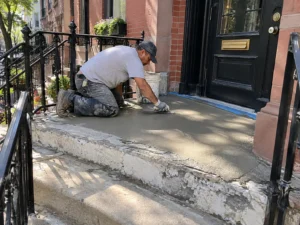
Small damaged areas may be repaired using compatible cementitious repair materials.
Before patching, loose and deteriorated concrete must be removed, and the remaining substrate must be sufficiently sound.
Proper surface preparation, bonding requirements, curing, and moisture conditions are essential for repair performance.
Concrete Resurfacing
When scaling affects a larger area but the underlying slab remains structurally sound, resurfacing may be an option.
A bonded cementitious overlay can restore the surface, but it requires more than simply spreading new material over damaged concrete.
The existing surface must be evaluated and prepared to meet the repair system’s requirements. This may include removing unsound concrete, cleaning, profiling the substrate, addressing cracks, and correcting drainage problems.
An overlay placed over delaminated concrete, active movement, or unresolved moisture problems can fail prematurely.
Partial-Depth Concrete Repair
Where deterioration extends below the surface, damaged concrete may need to be removed to a suitable depth.
If reinforcement corrosion is involved, the repair may require evaluating the steel, addressing corrosion, and restoring adequate protection around it.
The appropriate method depends on the condition and function of the affected slab.
Concrete Removal and Replacement
Replacement may be more practical when damage is widespread and deep, the slab has significant structural deterioration, or underlying problems make localized repairs unreliable.
Repeated patching does not solve a failing base, substantial movement, or serious deterioration throughout the concrete.
The decision between repair and replacement should consider the remaining sound concrete, underlying support, drainage, and intended use of the surface.
For damaged driveways and walkways, NY Concrete provides concrete repair services across its NYC service area.
How to Prevent Concrete From Flaking
Preventing concrete scaling begins with reducing unnecessary moisture exposure and making sure new concrete is properly installed.
Correct Drainage Problems
Concrete surfaces that remain saturated are more vulnerable to freeze-thaw deterioration.
Check where downspouts discharge, whether water collects in low spots, and whether the surface has appropriate drainage.
A driveway that remains wet long after surrounding areas have dried may need grading or drainage improvements.
Water management should be addressed before relying on sealers or surface repairs.
Use Deicing Products Carefully
Avoid unnecessary deicer use, especially on newly placed concrete.
Some deicing chemicals, including products containing ammonium sulfate or ammonium nitrate, can chemically damage concrete.
For new concrete, follow the concrete supplier’s and contractor’s guidance on winter exposure and deicer restrictions.
Remove snow promptly and consider sand for traction where appropriate.
Apply a Suitable Penetrating Sealer
A penetrating sealer can help reduce water and chloride absorption when used on compatible, sound concrete.
Application timing, surface preparation, weather conditions, and reapplication intervals depend on the product.
Sealers reduce exposure; they do not make concrete waterproof or correct existing structural damage.
Repair Cracks and Small Defects
Cracks, open joints, and damaged edges can create pathways for moisture.
Timely repair may help limit further deterioration, but the cause of recurring cracks should be investigated rather than repeatedly covered.
Specify Durable Concrete for New Work
For concrete exposed to NYC winters, discuss the following with your contractor:
- Appropriate air entrainment for freeze-thaw exposure.
- Suitable concrete strength and water-to-cementitious-materials ratio.
- Proper base preparation and drainage.
- Finishing methods appropriate for exterior concrete.
- Adequate curing and protection from early freezing.
- Appropriate joint placement and reinforcement cover where applicable.
These decisions influence how well concrete performs over repeated seasonal changes.
What This Means for NYC Properties
Concrete surfaces throughout New York City experience different combinations of moisture, temperature changes, deicing salts, traffic, and drainage conditions.
The surrounding property layout can influence where deterioration develops.
Brooklyn and Queens Residential Properties
Concrete walkways, narrow side passages, stoops, and driveways may remain damp where buildings or fences limit sunlight.
Water discharged from roofs and downspouts can increase moisture exposure in localized areas.
Manhattan Commercial Entrances
Busy entrances may experience repeated wetting, pedestrian traffic, cleaning, and winter deicer use.
Damaged concrete at entrances can also create uneven surfaces that require timely attention.
Staten Island Driveways
Residential driveways with varying slopes and drainage patterns may develop localized wet areas, particularly near low points, garage entrances, or curb transitions.
Where moisture repeatedly collects, identifying the drainage source is an important part of assessing concrete deterioration.
Public Sidewalks and NYC Requirements
Concrete work affecting public sidewalks may involve NYC Department of Transportation requirements that differ from those for work entirely on private property.
Property owners should review the current NYC DOT sidewalk repair guidance and confirm applicable permit and contractor requirements before beginning work.
When an On-Site Assessment Helps
If concrete flaking appears alongside hollow-sounding areas, rust stains, recurring wet spots, deep cracking, or exposed reinforcement, the damage may extend beyond the surface.
An on-site assessment can help determine whether the concrete needs localized repair, resurfacing, or replacement and whether drainage or other underlying conditions must be corrected first.
NY Concrete works with property owners across Brooklyn, Queens, Manhattan, and Staten Island to evaluate damaged driveways, walkways, steps, and other concrete surfaces.
Understanding why the concrete is deteriorating is the first step toward choosing a repair that addresses the actual problem rather than temporarily covering the symptoms.