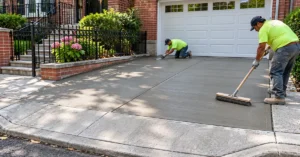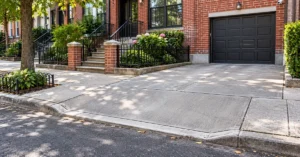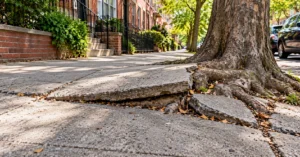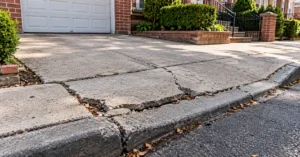
NYC sidewalk laws generally require property owners to maintain and repair the public sidewalks adjoining their buildings. Under Section 19-152 of the NYC Administrative Code, owners must address defective sidewalk conditions. If NYC DOT issues a sidewalk violation, owners generally have 75 days after receiving the notice to make the required repairs.
However, a sidewalk violation does not automatically mean a fine. NYC DOT states that the violation itself carries no fine, although the City may arrange repairs and bill the property owner if the defects remain unresolved.
Property owners also need to understand sidewalk permits, tree-root damage, winter maintenance, and the separate rules governing pedestrian injury liability.
Whether you own a house in Brooklyn, an apartment building in Queens, a commercial property in Manhattan, or a home on Staten Island, these rules can affect your maintenance responsibilities.
Here is what you need to know.
NYC Sidewalk Laws: The Essential Rules
New York City has several rules that affect sidewalk maintenance, repairs, and safety.
The following table summarizes the most important requirements.
| Rule | What property owners should know |
|---|---|
| Sidewalk maintenance | Owners generally maintain and repair the sidewalk adjoining their property under NYC Administrative Code § 19-152 |
| DOT sidewalk violations | NYC DOT can issue a notice when inspectors identify qualifying defects |
| Repair deadline | Owners generally have 75 days after receiving a violation notice to make the required repairs |
| Violation fines | A DOT sidewalk violation itself carries no fine, but City-arranged repairs may result in a bill |
| Construction permits | Sidewalk repair work generally requires the appropriate NYC DOT construction permit |
| City tree damage | Qualifying damage caused solely by City trees receives special treatment for one-, two-, and three-family properties |
| Snow and ice | Owners and occupants must meet separate NYC snow-removal requirements |
| Injury liability | NYC Administrative Code § 7-210 governs certain sidewalk injury claims and contains an exception for qualifying owner-occupied residential properties |
These requirements serve different purposes. For example, maintenance responsibility does not automatically establish the outcome of a personal injury claim.
Likewise, the absence of a fine for a DOT sidewalk violation does not eliminate the cost of required repairs.
1. Who Is Responsible for Sidewalk Repairs in NYC?
Under NYC Administrative Code § 19-152, property owners generally must install, repair, and maintain sidewalks adjoining their properties.
This responsibility covers residential and commercial properties.
For example, an owner may need to address broken concrete flags, uneven sections, missing sidewalk material, or other qualifying defects.
A sidewalk flag is an individual section of sidewalk, usually separated from neighboring sections by joints.
Although the sidewalk forms part of the public pedestrian area, that does not mean the City automatically pays for every repair.
NYC DOT expects owners to maintain the adjoining sidewalk and correct defects that require attention.
Does the Rule Apply to One-, Two-, and Three-Family Homes?
Yes. The general maintenance obligation also applies to these properties.
However, certain exceptions affect liability for injuries and repairs involving City-owned trees.
For example, Section 7-210 contains a specific exception to its liability-shifting provision for qualifying one-, two-, and three-family residential properties that are owner-occupied, at least in part, and used exclusively for residential purposes.
This exception does not mean those owners can ignore defective sidewalks. Nor does it necessarily eliminate every possible form of legal liability.
Therefore, owners should distinguish their responsibility to maintain the sidewalk from the legal rules that apply if someone suffers an injury.
For the official requirements, review NYC DOT’s Sidewalk Program.
2. What Sidewalk Defects Can Lead to an NYC DOT Violation?
NYC DOT inspects public sidewalks and may issue a Notice of Sidewalk Violation when inspectors identify qualifying defects.
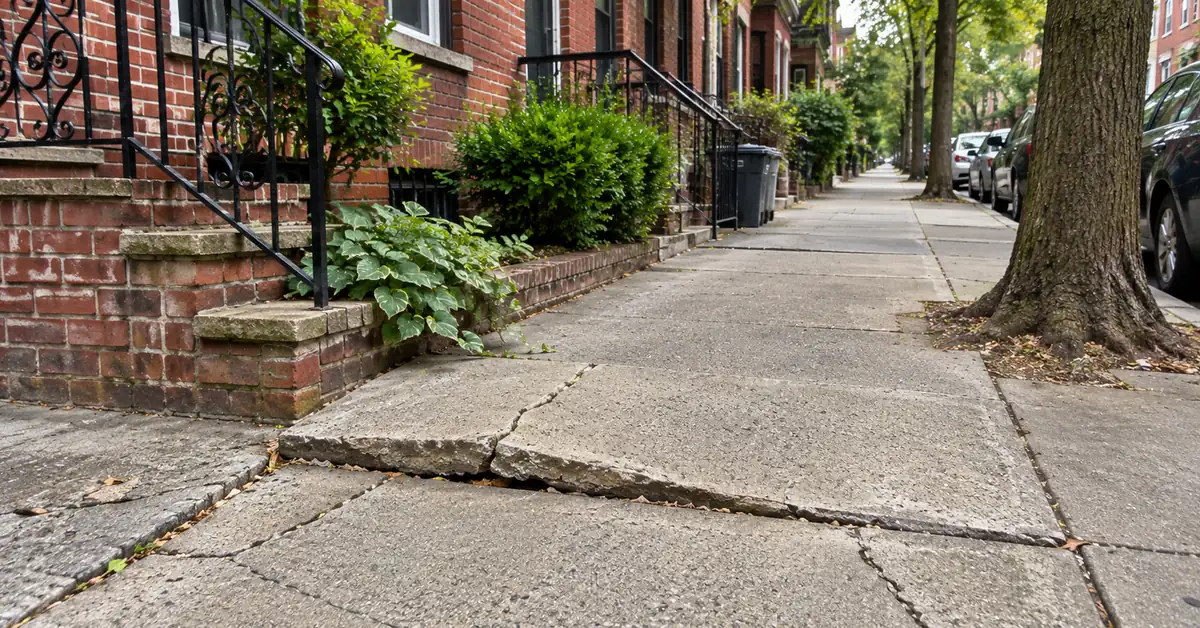
Common problems include cracked or missing sidewalk flags, uneven concrete, unstable sections, and inappropriate drainage slopes.
For example, a raised sidewalk flag can create a tripping hazard. Similarly, a void beneath a concrete section may leave the surface without adequate support.
NYC311 identifies several potentially defective conditions.
| Sidewalk condition | Why it matters |
|---|---|
| Uneven or raised concrete flags | Can create pedestrian trip hazards |
| Broken or missing sidewalk sections | May affect safe pedestrian access |
| Loose concrete | Can create unstable walking surfaces |
| Voids beneath sidewalk flags | May indicate an undermined condition |
| Improper sidewalk slope | Can contribute to drainage and accessibility problems |
| Protruding hardware or unsuitable patchwork | May create an obstruction or hazardous surface |
However, not every small crack automatically triggers a violation.
The specific condition, applicable standards, and DOT inspection findings determine what requires correction.
Additionally, an owner should not assume that a surface patch will satisfy a violation.
If DOT identifies particular defective flags for replacement, the required work must address those conditions according to the City’s specifications.
3. What Happens If You Receive an NYC Sidewalk Violation?
A Notice of Sidewalk Violation informs the property owner that NYC DOT identified defective sidewalk conditions.
The notice normally includes a Preliminary Inspection Report (PIR), which shows the affected sidewalk flags.
NYC DOT generally allows 75 days after the owner receives the notice to make the required repairs.
The timing matters because the City may arrange repairs and bill the property owner if the work remains incomplete.
Does an NYC Sidewalk Violation Come With a Fine?
No. NYC DOT states that the Notice of Sidewalk Violation itself carries no fine.
However, ignoring the notice can still create financial consequences.
For example, NYC DOT may perform the required work or assign a contractor. The Department of Finance may then bill the property owner for the repairs.
In addition, the violation remains on file with the County Clerk until the City officially confirms satisfactory repairs.
An unresolved notice may also complicate certain property transactions.
Therefore, owners should treat the notice seriously without assuming that it automatically imposes a monetary penalty.
When Does the 75-Day Period Begin?
According to NYC DOT, the period generally begins when the property owner receives the notice, as recorded by the certified mail receipt.
If delivery fails and the City posts the notice at the property, the posting date starts the period.
The same 75-day period applies throughout the year.
However, cold weather may affect when contractors can perform concrete work.
Obtaining a sidewalk construction permit does not automatically extend the repair deadline.
Can You Challenge an Incorrect Violation?
Yes. If the Preliminary Inspection Report identifies defects that do not match the actual sidewalk condition, the owner can request a reinspection.
NYC311 states that owners must submit this appeal within 75 days of receiving the notice.
However, requesting a reinspection is different from completing repairs and requesting dismissal.
Property owners should follow the applicable process for their situation.
For more information, visit NYC311’s Sidewalk Violation and Repair Guide.
4. Do Sidewalk Repairs Require an NYC DOT Permit?
Sidewalk construction and replacement generally require the appropriate NYC DOT permit.
Therefore, property owners should confirm permit requirements before work begins.
NYC DOT also recommends hiring contractors who understand the City’s sidewalk specifications.
When selecting a contractor, check the applicable licensing requirements and confirm that the proposed work addresses the identified sidewalk defects.
For qualifying home improvement work, NYC’s Department of Consumer and Worker Protection regulates contractor licensing.
In addition, repairs must follow the appropriate design and construction requirements.
These can include specifications for concrete, joint placement, sidewalk elevations, pedestrian access, and other project conditions.
However, not every repair project uses identical construction details. A contractor should determine the appropriate specifications from the location and scope of work.
How Do You Remove a Sidewalk Violation After Repairs?
Completing the concrete work does not automatically remove the violation from City records.
After the contractor finishes the permitted repairs, the owner must request a sidewalk violation dismissal inspection.
NYC DOT then checks whether the required repairs satisfy the applicable conditions.
Once the City confirms satisfactory work, it can notify the County Clerk so the violation record can be cleared.
Keep the permit number, violation number, inspection information, and repair documentation for your records.
You can also review NYC311 Sidewalk Construction Permit Information.
5. Who Pays When City Tree Roots Damage a Sidewalk?
City-owned tree roots can lift sidewalk flags and create uneven surfaces.
However, NYC has special rules for certain residential properties.
According to NYC DOT, the City no longer issues sidewalk violations or places liens on one-, two-, and three-family properties for sidewalk damage caused solely by City trees.
Additionally, the City does not charge these owners for qualifying sidewalk repairs caused by City-owned tree roots.
The situation differs for larger residential properties, commercial buildings, and vacant lots.
For example, owners of properties with four or more units generally remain responsible for sidewalk defects associated with tree roots.
Can a Property Owner Cut City Tree Roots?
No. Property owners and contractors should not cut or shave the roots of City-owned trees without appropriate authorization.
NYC Parks provides guidance and consultations concerning work near City trees.
Therefore, before starting sidewalk repairs near a street tree, confirm whether the damage qualifies for City assistance and what tree-protection requirements apply.
Avoid assuming that removing roots will solve the problem safely.
The correct repair may require coordination with NYC Parks and an approved sidewalk restoration approach.
For official information, consult NYC DOT’s Sidewalk Program.
6. NYC Snow Removal Rules and Sidewalk Injury Liability
Sidewalk responsibilities do not end when temperatures fall.
During winter, building owners and occupants must also follow NYC’s snow and ice removal requirements.
The Department of Sanitation requires a pedestrian path at least four feet wide.
Additionally, responsible parties must clear snow and ice around relevant sidewalk ramps, curb cuts, and fire hydrants.
How Long Do You Have to Clear Snow in NYC?
The deadline depends on when snowfall ends.
| When snowfall ends | Snow removal deadline |
|---|---|
| 7:00 AM–4:59 PM | Within 4 hours |
| 5:00 PM–8:59 PM | Within 14 hours |
| 9:00 PM–6:59 AM | By 11:00 AM |
NYC DSNY lists enforcement fines of $100 for a first offense, $150 for a second offense, and $250 for a third or subsequent offense.
These penalties concern snow and ice removal. They are separate from the DOT sidewalk repair violation process.
For current details, consult NYC DSNY Snow and Ice Removal Laws.
Can a Property Owner Be Liable for a Sidewalk Injury?
Potentially, yes.
NYC Administrative Code § 7-210 addresses liability for injuries caused by failure to maintain sidewalks in a reasonably safe condition.
However, the law contains an exception for certain one-, two-, and three-family residential properties that meet specific owner-occupancy and residential-use conditions.
Other legal principles and factual circumstances may still affect responsibility.
Therefore, the outcome of an injury claim depends on more than whether a sidewalk defect existed.
Property owners with specific legal questions should consult a qualified New York attorney.
How Can Property Owners Keep Their Sidewalks Compliant?
Regular maintenance can help identify developing problems before they become more serious.
Although NYC does not impose one universal inspection schedule on every property owner, proactive checks can help reveal defects that deserve attention.
Start with these practical steps:
-
Inspect the sidewalk periodically. Look for cracked, loose, missing, or uneven concrete flags.
-
Check drainage conditions. Notice whether water collects in low areas or flows toward the building.
-
Investigate tree-related movement. Determine whether City-owned roots may be affecting the sidewalk before disturbing them.
-
Address unsafe conditions promptly. Do not wait for a DOT notice when the sidewalk clearly needs attention.
-
Confirm permits before construction. Ask the contractor which approvals the repair requires.
-
Maintain winter access. Follow the City’s snow and ice removal deadlines.
-
Keep repair documentation. Save permits, inspection records, notices, and relevant photographs.
If you receive a DOT violation, use the Preliminary Inspection Report to understand the required scope.
For more detailed information about the repair process, see NY Concrete’s Sidewalk Repair Services.
Frequently Asked Questions About NYC Sidewalk Laws
Who is responsible for repairing the sidewalk in front of a house in NYC?
The adjoining property owner generally must maintain and repair the sidewalk under NYC Administrative Code § 19-152. However, separate rules affect qualifying City-tree damage and liability for injuries at certain owner-occupied residential properties.
How long do I have to fix an NYC DOT sidewalk violation?
Property owners generally have 75 days after receiving the Notice of Sidewalk Violation to make the required repairs. The period also applies during winter, although weather may affect construction scheduling.
Does an NYC DOT sidewalk violation carry a fine?
No. NYC DOT states that the sidewalk violation itself carries no fine. However, if the City arranges the required repairs, it may bill the property owner. Other sidewalk-related offenses, such as snow-removal violations, have separate penalties.
Does NYC pay for sidewalk repairs caused by tree roots?
The City has special provisions for qualifying one-, two-, and three-family properties when City-owned trees are solely responsible for the damage. However, larger properties and commercial buildings generally have different obligations.
Can I repair a sidewalk without a permit in NYC?
Do not assume you can begin sidewalk construction without approval. NYC DOT generally requires permits for sidewalk repair work. Confirm the applicable requirements before starting a project.
Does fixing the sidewalk automatically remove a DOT violation?
No. After completing permitted repairs, the owner must request a dismissal inspection. NYC DOT must confirm satisfactory work before the violation can be cleared from the official record.
Are commercial property owners responsible for sidewalk maintenance?
Yes. Commercial property owners generally must maintain the adjoining sidewalk and address qualifying defects. The repair scope and applicable permits depend on the location and conditions.
Need Help With NYC Sidewalk Repairs?
Understanding NYC sidewalk laws is the first step. However, the required work depends on the sidewalk’s actual condition and any defects identified by NYC DOT.
NY Concrete provides sidewalk repair and replacement services across Brooklyn, Queens, Manhattan, and Staten Island.
Whether you have cracked concrete flags, uneven sections, or an outstanding DOT violation, our team can review your repair needs and discuss the appropriate scope.
We can also help you understand the construction work associated with the applicable repair requirements. Any required official inspection and dismissal must follow NYC DOT procedures.
Explore our services:
Request a free on-site sidewalk repair estimate.
Contact NY Concrete or call 718-980-8580.
When requesting an estimate, include your property’s borough, the approximate damaged area, and whether you have received a DOT sidewalk violation notice.
This article provides general information about NYC sidewalk requirements as of November 2026. It does not replace official agency instructions or professional legal advice.