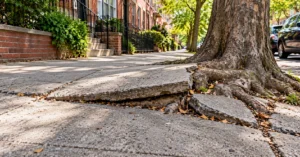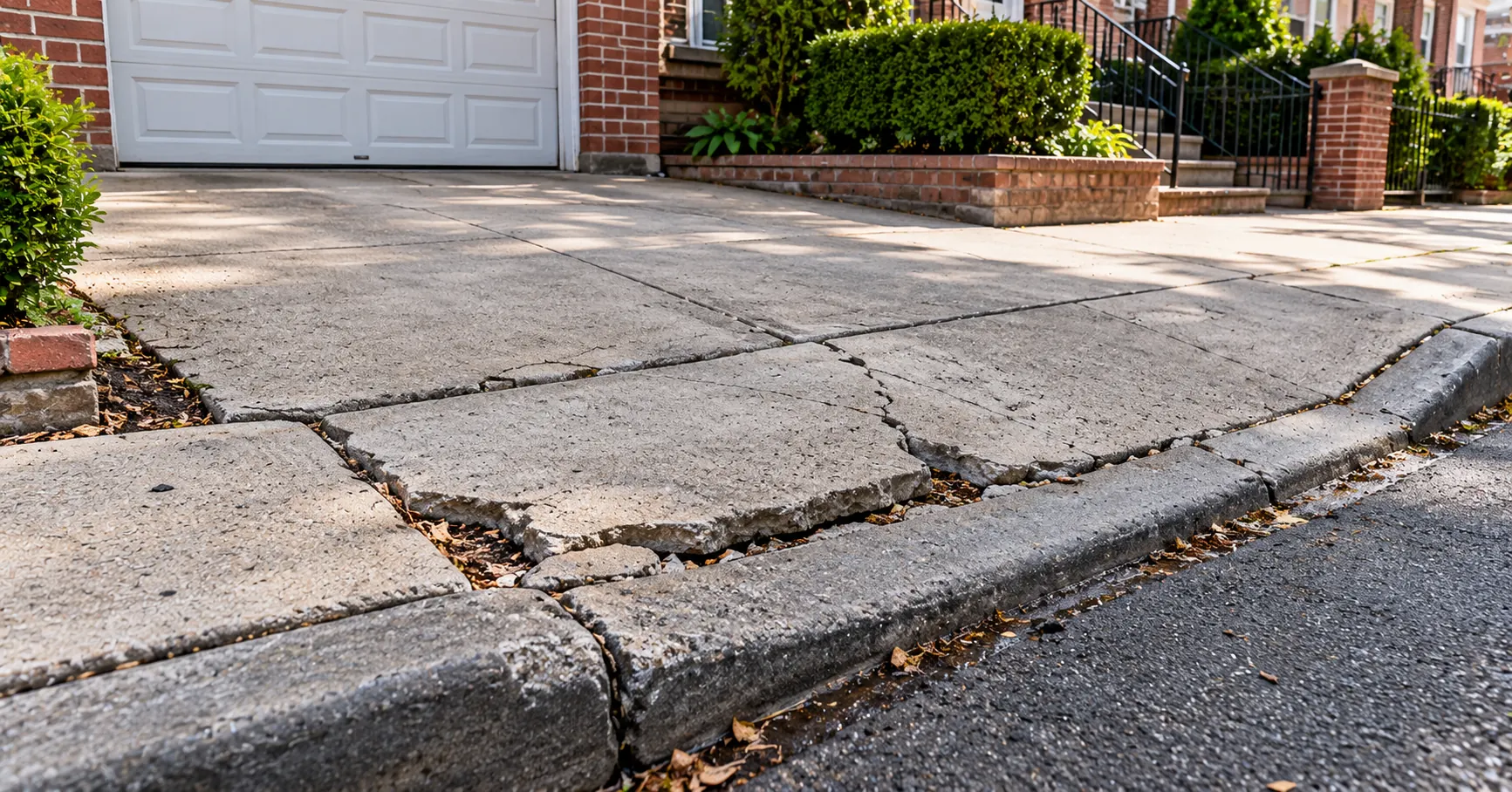
A damaged driveway does not always start with cracks near the garage. Sometimes, the first problem appears where the driveway meets the sidewalk or street.
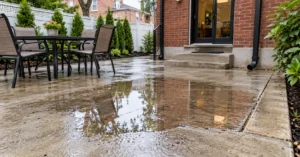
You might notice a broken concrete edge, a sinking section, or an uneven transition that causes your vehicle to scrape against the pavement. Water may also collect near the curb after heavy rainfall.
This area often receives more wear than the rest of the driveway. Every vehicle entering or leaving the property passes over it, while rainwater, winter freezing, and ground movement can gradually affect the concrete.
For NYC property owners, driveway apron repair can also raise questions about responsibility and permits.
Does the homeowner pay for the repair? Is the damaged concrete part of the sidewalk? Can you replace the apron without city approval?
The answers depend on the location of the damage and the type of construction involved.
Understanding those differences can help you avoid unnecessary work, permit problems, and recurring concrete damage.
Quick Answer: Who Is Responsible for Driveway Apron Repair in NYC?
NYC property owners are generally responsible for maintaining the sidewalks adjoining their properties, including affected sidewalk areas at driveway entrances. However, curbs are City-owned, and responsibility for curb repairs is not necessarily the same as responsibility for sidewalk maintenance.
Permit requirements depend on the exact work. Repairing an existing concrete transition may require NYC DOT authorization, while creating or changing a curb cut involves NYC Department of Buildings approval and applicable DOT permits.
Before beginning repairs, identify whether the damage affects private driveway concrete, the public sidewalk, the curb, or the approved curb-cut configuration.
What Is a Driveway Apron?
A driveway apron is the transition area connecting a private driveway to the street or sidewalk crossing.
It allows vehicles to move between the road and the property.
The exact layout varies by location. Some entrances include a sloped sidewalk crossing, while others have a distinct concrete transition near the curb.
Although this area may look like part of the driveway, portions can fall within the public right-of-way.
That difference matters because private driveway work and construction affecting City sidewalks or curbs can have different requirements.
A property owner should not assume that the entire entrance is private concrete simply because vehicles use it to access the property.
Why Driveway Aprons Crack, Sink, or Break
Driveway entrances experience repeated vehicle loading, weather exposure, and changes in ground conditions.
Over time, several problems can develop.
Repeated Vehicle Pressure
Every vehicle entering the driveway crosses the transition area.
If the concrete has poor support, unsuitable thickness, or existing damage, repeated loads can contribute to cracking and edge deterioration.
Heavy vehicles may place additional stress on areas that were not designed for those loads.
Settlement Beneath the Concrete
A driveway apron may sink when the supporting soil or aggregate moves.
Poor compaction, erosion, or changes in moisture can create voids beneath the concrete.
As support decreases, sections may settle unevenly.
The result can be a noticeable dip where the driveway meets the sidewalk or street.
Poor Drainage
Water often collects near driveway entrances because of changes in elevation.
If the area has an unsuitable slope, rainwater may remain along the transition.
Repeated water exposure can contribute to base erosion and deterioration, especially when water enters existing cracks and joints.
During freezing weather, trapped moisture may also contribute to further cracking.
Deteriorating Concrete Edges
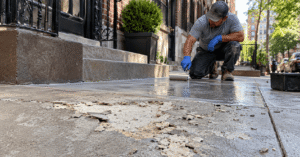
Concrete edges may begin chipping or breaking when they lose support or experience repeated impact.
A small broken corner may seem harmless at first. However, deterioration can spread if the surrounding concrete continues moving or breaking apart.
The important question is whether the damage remains localized or indicates a larger problem beneath the surface.
Signs Your Driveway Apron Needs Attention
Not every surface mark requires major repairs.
However, changes that affect vehicle access, drainage, or pedestrian safety deserve closer inspection.
Common warning signs include cracks spreading through the transition, broken concrete near the curb, uneven elevations, and sinking sections.
Some property owners notice that their vehicle scrapes the pavement when entering the driveway. Others see standing water or damaged concrete along the sidewalk crossing.
A sudden change in elevation may also create a pedestrian tripping hazard.
If several problems appear together, a contractor should assess the entire entrance rather than recommend a small surface patch.
Repairs should address the cause of the damage whenever practical.
Who Pays for Driveway Apron Repair in NYC?
Responsibility depends on which part of the entrance needs work.
Under NYC Administrative Code Section 19-152, property owners generally must maintain sidewalks adjoining their properties.
That obligation can include defective sidewalk concrete within a driveway entrance.
However, NYC311 identifies curbs as City-owned roadway elements.
Property owners are encouraged to report damaged curbs, and NYC DOT may repair or replace defective curbs in certain circumstances.
This does not mean the City automatically pays for every driveway entrance problem.
For example, a project involving a privately requested curb-cut alteration may place costs and permitting responsibilities on the applicant.
If the damage resulted from another contractor or utility work, documentation may help determine whether reimbursement is possible.
The safest approach is to identify the damaged element before assigning responsibility or approving construction.
For official guidance, see the NYC DOT Sidewalk Program and NYC311’s curb and driveway information.
Do You Need a Permit for Driveway Apron Repair in NYC?
Permit requirements depend on what the contractor plans to do.
Ordinary repairs to private driveway concrete do not always follow the same approval process as work within the public sidewalk or curb.
When construction affects a sidewalk or curb, NYC DOT permits may apply.
The requirements become more involved if the project creates, relocates, widens, or otherwise changes a curb cut.
A curb cut is the approved vehicle-access opening that allows a driveway to connect with the street.
NYC’s Department of Buildings requires plans and approval for curb-cut construction. Related sidewalk and curb work also involves DOT requirements.
You cannot simply lower a curb or create a new driveway entrance without the appropriate authorization.
An existing curb cut should not be widened or modified merely because a wider entrance would make parking easier.
Before starting the project, ask which agency approvals apply and who will handle the permit process.
The official NYC Department of Buildings curb-cut guide explains the approval process.
Can You Repair a Driveway Apron Without Replacing the Whole Driveway?
Often, yes.
A damaged apron does not automatically mean the entire driveway has failed.
If most of the driveway remains stable, a contractor may recommend repairing or replacing only the affected transition.
The decision depends on the condition of the existing concrete, surrounding joints, supporting base, and drainage.
A localized repair may work when damage is limited and the remaining concrete has adequate support.
However, repeated settlement or extensive cracking may require more substantial reconstruction.
The contractor also needs to consider how the new concrete will meet the existing driveway and sidewalk.
Poor elevation matching can create another uncomfortable vehicle transition or redirect water toward the property.
The repair should improve both surface condition and everyday access.
How Is a Concrete Driveway Apron Repaired?
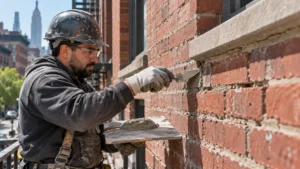
A professional repair begins with an assessment of the damaged area.
The contractor examines the concrete, surrounding elevations, vehicle access, and drainage conditions.
If the work affects the public right-of-way, necessary approvals must be obtained before construction.
The required construction steps then depend on the approved scope.
For concrete replacement, the crew may remove the damaged material and examine the supporting ground.
The base may need excavation, grading, and compaction before workers place new concrete.
The replacement must also meet applicable requirements for concrete specifications, finishing, joints, drainage, and the sidewalk or curb transition.
After placement, the concrete needs suitable curing conditions.
Property owners should confirm when vehicles can safely use the repaired entrance.
The objective is not simply to replace broken concrete. It is to restore a functional transition without creating new drainage, accessibility, or vehicle-clearance problems.
How Much Does Driveway Apron Repair Cost in NYC?
Driveway apron repair costs vary based on the location, extent of damage, and construction requirements.
A localized concrete repair can involve less work than replacing the entire transition.
However, the cost may increase when the project requires demolition, excavation, base reconstruction, permits, or modifications to surrounding concrete.
Site access also matters.
Some NYC properties have narrow driveways or limited staging space, making material delivery and debris removal more complicated.
Other factors include drainage corrections, curb conditions, concrete specifications, and any required sidewalk reconstruction.
A reliable estimate should explain the proposed scope rather than offer only a total price.
Before choosing a contractor, confirm whether the estimate includes demolition, base preparation, concrete work, permit responsibilities, cleanup, and any necessary inspections.
It is also worth asking how the contractor plans to prevent the same damage from returning.
What If You Receive a Sidewalk Violation Near Your Driveway?
A damaged driveway entrance can sometimes involve a sidewalk defect.
NYC DOT may issue a sidewalk violation when inspectors identify qualifying problems such as broken sidewalk flags, unsafe elevation changes, or improper slopes.
If the damaged area appears on the Preliminary Inspection Report, the owner needs to address the cited defects according to the applicable requirements.
The City generally provides 75 days after receipt of a Notice of Sidewalk Violation to complete the required repairs.
A sidewalk construction permit does not automatically extend that period.
Once privately completed repairs are finished, the property owner generally needs to request a dismissal inspection.
This matters because repairing the concrete and officially clearing the violation are separate steps.
For more information about the process, read NY Concrete’s sidewalk violation removal guide.
Why Driveway Apron Repairs Require Careful Planning in NYC
Driveway entrances differ across New York City’s residential neighborhoods.
In Brooklyn and Queens, some properties have narrow entrances connecting the street to garages or private parking areas.
Staten Island homes may have longer driveways where surface slope and drainage influence the entrance.
Certain Manhattan properties have limited vehicle-access areas with additional space constraints.
These examples demonstrate why the repair should reflect the actual property layout.
A contractor must consider the relationship between the driveway, public sidewalk, curb, and roadway.
The finished surface should support safe vehicle movement while preserving applicable pedestrian access and drainage requirements.
That is especially important when work crosses the boundary between private property and the public right-of-way.
Common Driveway Apron Repair Mistakes
One mistake is patching a broken concrete edge without checking whether the supporting base has settled.
If movement continues, the new material may crack or separate.
Another mistake is changing the apron slope without considering the vehicle’s approach angle.
An unsuitab