You may not need a permit for minor driveway maintenance in NYC, such as sealing small cracks or making limited surface repairs. However, constructing or altering a driveway generally requires approval, and work involving a curb cut, public sidewalk, or street may require permits from the NYC Department of Buildings (DOB) or Department of Transportation (DOT).
The key difference is where the work takes place and what the contractor plans to change.
For example, sealing a small crack on an existing private driveway is different from widening the driveway or rebuilding the entrance across the public sidewalk.
Likewise, replacing a damaged concrete section within your property may involve different requirements from modifying a curb cut.
Before starting driveway repairs in Brooklyn, Queens, Manhattan, or Staten Island, property owners should understand these distinctions.
This guide explains which projects may qualify for permit exemptions, when approvals become necessary, and how to check the requirements before construction.
When Do You Need a Driveway Repair Permit in NYC?
Not every driveway project involves the same permits.
NYC DOB regulates applicable construction and alterations on private property, including curb cut approvals. Meanwhile, NYC DOT regulates construction affecting public sidewalks, curbs, and roadways.
The table below provides a general overview.
| Type of driveway work | General permit considerations |
|---|---|
| Sealing minor cracks on private property | May qualify as ordinary maintenance without a DOB construction permit |
| Minor surface patching | May qualify for an exemption if the work remains within the applicable limits |
| Resurfacing an existing private driveway | Depends on the scope and whether the work qualifies as ordinary repair |
| Replacing part of a driveway | Requires a project-specific review of the proposed work |
| Removing and replacing an entire driveway | Confirm DOB requirements before demolition; do not assume automatic exemption |
| Widening or extending a driveway | Generally involves an alteration requiring DOB review and applicable approvals |
| Installing or modifying a curb cut | Requires DOB approval and the appropriate DOT permits |
| Repairing the public sidewalk at a driveway crossing | DOT permit requirements apply according to the repair area and purpose |
| Changing drainage or utility connections | May require additional approvals depending on the proposed system |
These examples are general guidance, not individual permit determinations.
The most reliable approach is to define the construction scope first and then verify which approvals apply.
For official information, review the NYC311 Garage or Driveway Permit Guide.
Driveway Repairs That May Not Require a Permit
Some maintenance activities may qualify for exemptions under NYC’s ordinary repair rules.
However, these exemptions do not allow property owners to ignore zoning, drainage, or other applicable requirements.
Minor Driveway Crack Repairs
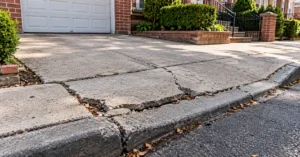
Small cracks can develop from concrete shrinkage, weather exposure, settlement, or other conditions.
When the concrete remains stable, a suitable crack repair may help maintain the surface.
For example, sealing a narrow, stable crack on an existing private driveway generally involves less extensive work than reconstructing the slab.
Such maintenance may not require a DOB construction permit when it qualifies under the applicable exemption.
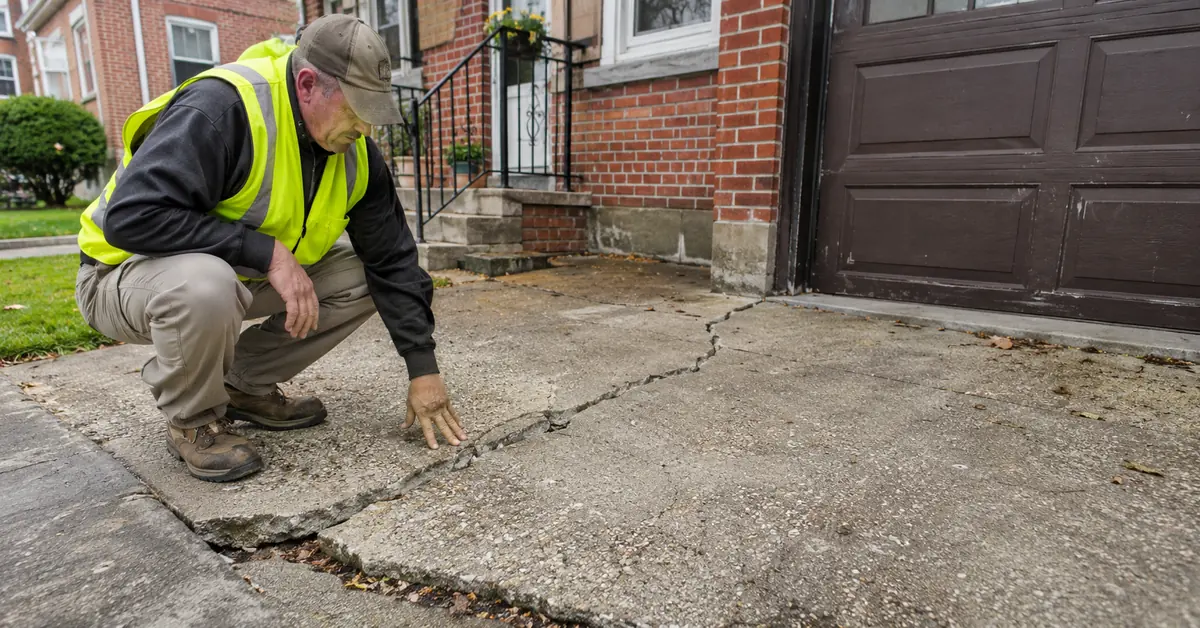
However, a widening crack accompanied by settlement may indicate a problem requiring more substantial work.
Therefore, the contractor should assess the actual condition before choosing the repair method.
Surface Sealing and Limited Maintenance
Applying a compatible sealer or performing routine surface maintenance may also qualify as ordinary repair work.
Nevertheless, an exemption is not automatic for every product or procedure.
For example, removing large areas of concrete, changing the driveway’s grade, or modifying drainage can introduce requirements beyond simple maintenance.
The important question is whether the work remains an ordinary repair or constitutes a regulated alteration.
Small Concrete Patches
Localized repairs may be appropriate when a limited section of the driveway has deteriorated.
However, the construction method and location matter.
A small repair entirely within private property is different from a repair that extends across the property line into the public sidewalk.
Therefore, contractors should identify the work boundaries before assuming that a project needs no permit.
Important: NYC DOB recognizes exemptions for certain minor alterations and ordinary repairs. However, exempt work must still comply with applicable laws and regulations.
You can review NYC DOB’s Do I Need a Permit? guidance.
When Is a Permit Required for Driveway Construction or Alterations?
More extensive driveway work may require formal approval.
NYC311 states that constructing or altering a driveway requires a permit.
Therefore, property owners should carefully review projects that change the driveway’s location, size, access, or construction.
Widening or Extending a Driveway
Expanding a driveway can involve more than placing additional concrete.
For example, increasing the paved area may affect permitted parking arrangements, required yard space, drainage, and zoning compliance.
Even when the work stays within private property, the change may qualify as an alteration.
Consequently, owners should confirm the proposed layout before construction.
A contractor should not widen a driveway simply because the property appears to have enough available space.
Complete Driveway Replacement
Removing and replacing an entire driveway may involve excavation, base reconstruction, grading, and new concrete or asphalt.
However, the permit determination depends on the actual scope.
For example, a replacement that alters the driveway’s footprint, drainage, or access arrangement may raise different issues from limited maintenance of an existing surface.
Because NYC regulates driveway construction and alterations, confirm whether the proposed replacement requires DOB approval before beginning demolition.
Do not assume that maintaining the same general appearance automatically qualifies the project for an exemption.
Changing the Driveway’s Grade or Drainage
Driveway reconstruction may also affect how rainwater moves across the property.
For example, raising the finished surface could send runoff toward the garage, neighboring property, or public sidewalk.
A project involving new drainage connections, significant grading changes, or other regulated work may require additional review.
Therefore, the construction plan should identify both the finished elevations and the intended drainage system.
For a closer look at drainage-related concrete damage, read How Poor Drainage Damages Concrete Driveways.
What Is a Curb Cut, and When Do You Need Approval?
A curb cut is a lowered section of the curb and sidewalk that allows vehicles to enter a driveway, garage, or parking area from the street.
NYC DOB regulates curb cut projects to confirm compliance with applicable size, location, and zoning requirements.
In addition, NYC DOT controls relevant construction work within the public right-of-way.
Do You Need a Permit for a New Curb Cut?
Yes.
Creating a new curb cut generally requires DOB approval of plans prepared by an appropriate registered design professional.
The project also requires relevant construction permits, including applicable DOT approvals.
For example, a homeowner cannot simply remove part of a street curb to create a new driveway entrance.
The proposed curb cut must comply with the City’s rules.
What About Widening an Existing Curb Cut?
Widening or relocating an existing curb cut also requires appropriate review and approvals.
The contractor or design professional must evaluate the proposed dimensions, location, and applicable zoning conditions.
Additionally, the work may affect sidewalk construction, pedestrian access, or surrounding infrastructure.
Therefore, modifying the existing curb opening should not begin without confirming the necessary approvals.
Can You Repair an Existing Driveway Apron?
The driveway apron is the transitional area between the private driveway and the street access, often involving the public sidewalk crossing.
Repair requirements depend on the exact portion of the apron and the work being performed.
For example, reconstructing defective concrete within the public sidewalk may require a DOT Sidewalk Construction Permit.
However, repairing a section of sidewalk without changing the existing approved curb cut is not necessarily the same as applying for a new curb cut.
The contractor should determine whether the project involves sidewalk restoration, curb cut alteration, or both.
Official reference: NYC DOB Curb Cut Project Requirements.
Does Repairing the Driveway Sidewalk Crossing Require a DOT Permit?
Public sidewalk work follows specific NYC DOT requirements.
Under NYC Highway Rules § 2-09, a sidewalk construction permit is generally required when the work involves more than 25 square feet.
For an area of 25 square feet or less, a sidewalk construction permit is required when the purpose of the work is to remove a sidewalk violation.
However, additional approvals may apply depending on the location and construction activity.
What About Concrete Thickness at Driveway Crossings?
NYC DOT’s standard sidewalk requirements distinguish ordinary pedestrian sections from driveway crossings.
The standard rule identifies:
-
4-inch concrete for ordinary sidewalk sections.
-
7-inch concrete for driveway crossings and corner quadrants.
These are published standard details, subject to applicable approved plans and project-specific requirements.
Therefore, a contractor should not automatically reconstruct a driveway crossing using the same concrete section as an ordinary pedestrian sidewalk.
In addition, the project must follow applicable requirements for foundation preparation, joints, grading, and finishing.
Official reference: NYC Highway Rules § 2-09.
How Do You Apply for a Driveway Permit in NYC?
The application process depends on the proposed construction.
A project involving only an eligible minor repair may not require the same process as a driveway alteration or curb cut.
However, when approvals are necessary, the following steps provide a useful starting point.
Step 1: Define the Construction Scope
First, identify exactly what the contractor plans to repair or replace.
For example, determine whether the project involves the private driveway, public sidewalk, curb, driveway apron, or drainage system.
Additionally, confirm whether the finished driveway will maintain its existing size and location.
These details help determine which requirements apply.
Step 2: Identify the Responsible Agency
Next, check whether NYC DOB, NYC DOT, or another agency needs to review the work.
DOB generally handles applicable building and driveway construction approvals, while DOT handles regulated public sidewalk and curb construction.
Curb cut projects may involve approvals from both agencies.
If the property has landmark status, additional review may apply.
Step 3: Prepare the Required Documents
Depending on the project, an application may require a property survey, construction drawings, site information, or other documentation.
Curb cut projects generally require a registered design professional to prepare and submit the necessary plans.
Therefore, homeowners should not assume that a basic contractor estimate is sufficient for a regulated alteration.
Step 4: Submit the Application
NYC DOB uses DOB NOW for applicable electronic permit filings.
NYC DOT uses its own permit systems for qualifying work within the public right-of-way.
The responsible professional or contractor should identify the applicable filing procedure.
Step 5: Confirm Approval Before Construction
Once the appropriate agency issues the required permit, the contractor can proceed according to the approved scope and permit conditions.
However, application submission does not itself authorize construction.
The contractor should also confirm applicable inspections and project closeout requirements.
Permit approval times vary. Property owners should not rely on a universal estimate of a few days or weeks without confirmation for their specific application.
Do NYC Driveway Permits Have Special Zoning or Landmark Requirements?
Some projects require additional consideration beyond concrete construction.
For example, NYC zoning rules can regulate off-street parking, driveway access, yard areas, and curb cut locations.
Therefore, property owners should confirm that an existing or proposed driveway arrangement is lawful before modifying it.
Historic Districts and Landmarked Properties
If a property is an individual landmark or sits within an NYC historic district, certain exterior driveway changes may require Landmarks Preservation Commission (LPC) approval.
The LPC’s permit guidance addresses driveway materials, layout changes, and work within historic yards.
Consequently, owners should confirm designation status before planning significant exterior alterations.
Official reference: NYC Landmarks Preservation Commission.
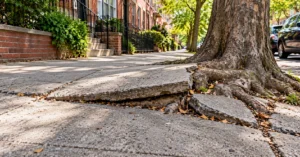
Street Trees and Nearby Infrastructure
Driveway construction near City-owned street trees may also require additional coordination.
For example, excavation could affect tree roots or nearby public infrastructure.
Property owners should not authorize root cutting or other regulated work without the necessary approvals.
A project that appears to involve only concrete paving may require more detailed planning when surrounding conditions introduce additional restrictions.
What Happens If You Repair a Driveway Without the Required Permit?
Unpermitted work can create problems when the project requires official approval.
Depending on the circumstances, the City may issue violations, require corrective work, or impose other enforcement measures.
For example, an unauthorized curb cut can create significant regulatory problems because it affects public access and zoning compliance.
Property owners may also encounter difficulties during later property improvements when the existing work lacks required approvals.
However, not every small driveway repair needs a construction permit.
Therefore, the goal is not to obtain unnecessary permits. It is to identify and secure the approvals that the project actually requires.
Before starting regulated work, ask the contractor to provide the permit information and explain the responsibilities of the owner and contractor.
What Should You Ask a Driveway Repair Contractor Before Hiring?
A good written estimate should explain more than the concrete repair itself.
It should identify the work location, proposed method, and any applicable permit responsibilities.
Before hiring a contractor, ask:
-
Does the project involve only private property or also the public sidewalk?
-
Are we repairing the existing driveway or changing its dimensions?
-
Will the work affect the approved curb cut?
-
Do we need DOB, DOT, or other agency approvals?
-
Who will prepare and submit the required paperwork?
-
Does the estimate include excavation, base preparation, drainage, and cleanup?
-
What inspections or final approvals will be required?
-
Can I verify the contractor’s applicable license and insurance?
For residential home improvement projects, NYC DCWP regulates applicable Home Improvement Contractor licensing.
You can check contractor credentials through the NYC DCWP Home Improvement Contractor resources.
Additionally, request a written agreement identifying the work and any exclusions.
Frequently Asked Questions About NYC Driveway Repair Permits
Do I need a permit to repair cracks in my driveway in NYC?
Minor crack sealing on an existing private driveway may qualify as ordinary maintenance without a DOB construction permit. However, larger repairs or work involving public property can trigger different requirements.
Do I need a permit to replace my entire concrete driveway?
The requirement depends on the project’s scope. Since NYC regulates driveway construction and alterations, confirm DOB requirements before complete demolition or reconstruction. Changes to layout, grading, drainage, or access may affect the permit determination.
Do I need a permit to widen my driveway in NYC?
Driveway widening generally involves an alteration that requires review under NYC’s applicable construction and zoning rules. A project affecting a curb cut also requires the relevant DOB and DOT approvals.
Is a driveway apron part of the public sidewalk?
A driveway apron can include the portion of a vehicle entrance crossing the public sidewalk. Work in that area may fall under DOT sidewalk requirements, depending on the exact repair boundaries and construction scope.
Do I need a permit to repair a driveway curb cut?
Curb cut construction or alteration requires appropriate approval. However, limited sidewalk repair at an existing entrance may follow a different permit process. The exact work determines which approvals apply.
Which NYC agency issues driveway permits?
NYC DOB handles applicable driveway and curb cut construction approvals. NYC DOT issues permits for qualifying construction affecting public sidewalks, curbs, and roadways. Some projects require coordination between both agencies.
Can my contractor apply for the permits?
Qualified contractors and registered design professionals can handle applicable filings according to the permit type. However, the property owner should confirm who is responsible for applications, fees, inspections, and final approval.
How long does a driveway permit take in NYC?
Processing time varies by agency, project scope, application completeness, and required reviews. There is no reliable universal approval period for every driveway project.
Need Driveway Repair or Replacement in NYC?
Before repairing or reconstructing a driveway, it is important to identify the actual damage and determine which construction requirements apply.
For example, a stable concrete crack may need a relatively limited repair. However, significant settlement, damaged driveway crossings, or changes to street access can involve a more extensive scope.
NY Concrete provides driveway repair and replacement services throughout Brooklyn, Queens, Manhattan, and Staten Island.
Our team can discuss visible cracking, sinking concrete, drainage concerns, and driveway reconstruction needs to help establish an appropriate estimate.
For projects requiring official approvals, confirm the applicable permit and professional responsibilities before construction begins.
Explore Our NYC Driveway Repair Services
Request a free on-site driveway repair estimate.
Contact NY Concrete or call 718-980-8580.
When requesting an estimate, share your borough, the affected driveway area, and whether the work involves your garage entrance, curb cut, or public sidewalk.
This article provides general information about NYC driveway permit requirements as of November 2026. Actual approvals depend on the property, project scope, and applicable City regulations. Confirm the requirements with the appropriate agency before beginning work.