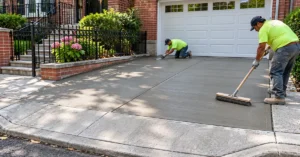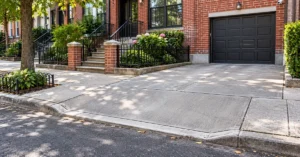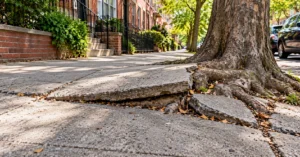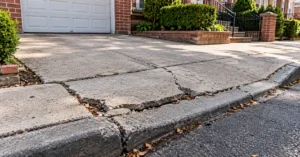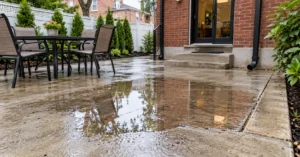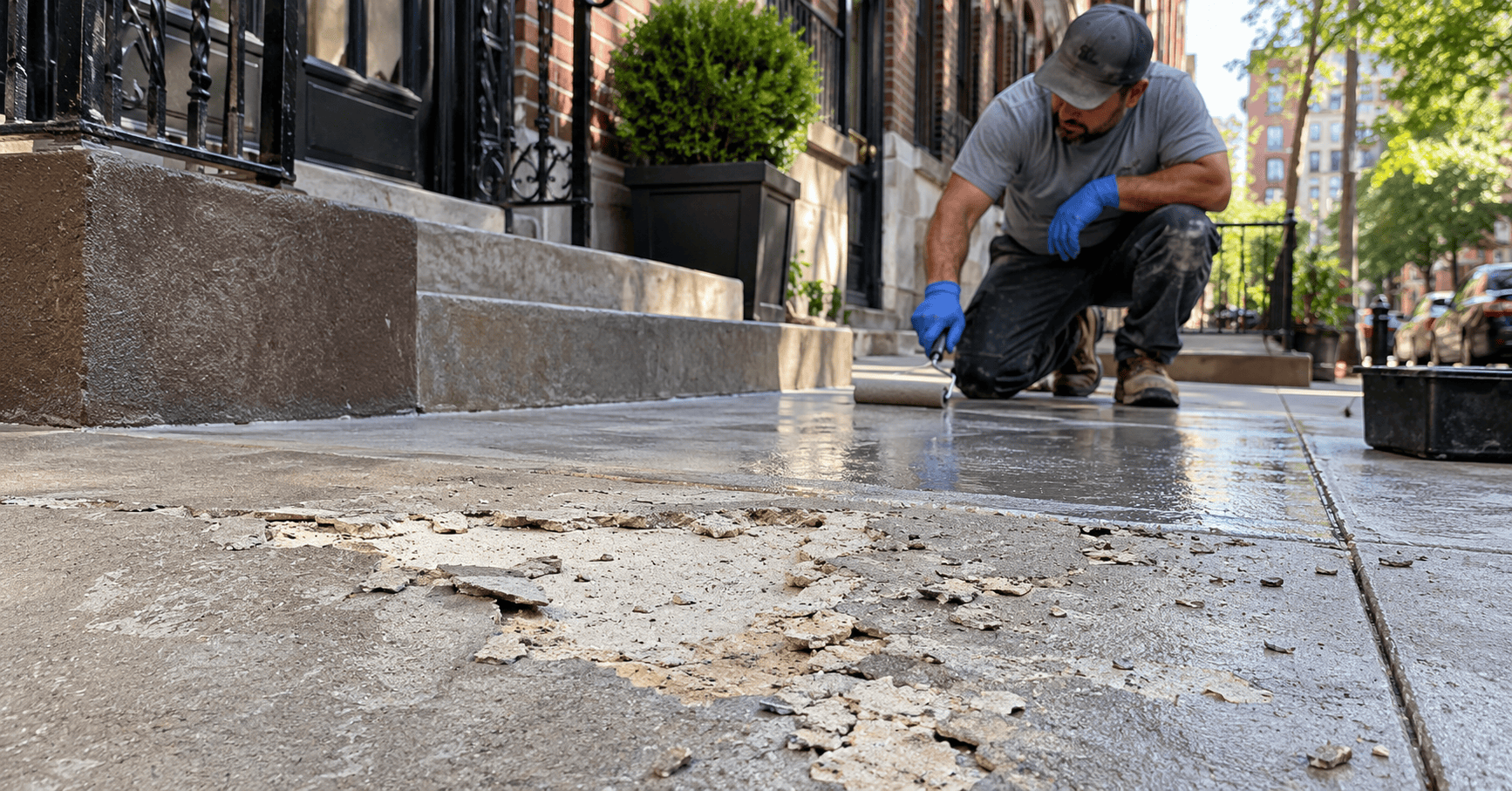
Concrete flaking usually happens when the surface becomes weak and begins losing thin layers of cement paste. Common causes include freeze-thaw damage, deicing salts, trapped moisture, improper finishing, and inadequate curing.
If your driveway looks rough after winter, your sidewalk is shedding small pieces, or your concrete steps are beginning to peel, the damage may be more than ordinary wear.
The good news is that not every flaking surface needs to be replaced. Some problems can be managed with targeted repairs, while others require resurfacing or a new concrete section.
The key is identifying what’s causing the deterioration before choosing a repair.
What Does Flaking Concrete Look Like?
Concrete flaking often starts with small patches that feel rough, sandy, or uneven. Over time, larger pieces may break away, exposing the aggregate beneath the surface.
Contractors may describe this type of deterioration as concrete scaling, although similar-looking damage can have different underlying causes.
Here is how to distinguish the common signs.
| What you notice | What it could indicate |
|---|---|
| Fine flakes or sandy material across the surface | Surface scaling or weak cement paste |
| Thin layers peeling away | Weak surface layer or delamination |
| Small, rounded pits | Concrete popouts associated with aggregate particles |
| Larger chunks breaking away | Deeper spalling or more extensive deterioration |
| Rust stains near broken concrete | Possible reinforcement corrosion |
| Flaking concentrated in low spots | Persistent moisture or poor drainage |
These observations are useful starting points, not a substitute for a proper inspection.
A driveway that is losing a thin surface layer needs a different repair approach from concrete steps with deep cracks or exposed steel.
6 Common Causes of Concrete Flaking
Concrete is durable, but its performance depends on the mixture, installation, curing, drainage, and environmental exposure.
Several factors can contribute to surface deterioration at the same time.
1. Freeze-Thaw Damage
One of the most common causes of outdoor concrete scaling is repeated freezing and thawing.
Concrete contains tiny pores that can absorb moisture. When sufficiently saturated concrete freezes, ice formation creates internal pressure within its pore structure.
If the concrete cannot accommodate that pressure, microscopic damage may develop.
As freezing and thawing continue, the surface can gradually lose strength and begin shedding small pieces.
This is especially relevant for NYC properties where outdoor concrete remains exposed to winter moisture and temperature changes.
What to look for: Rough patches or peeling surface mortar appearing after winter, particularly in areas that stay wet.
2. Deicing Salts
Deicing chemicals help manage slippery winter conditions, but they can also contribute to concrete scaling.
Salt exposure can intensify freeze-thaw deterioration, especially when concrete repeatedly becomes wet and saturated.
Some deicing chemicals can also cause additional chemical deterioration.
New concrete can be particularly vulnerable if it has not developed sufficient durability before winter exposure.
What to look for: Surface damage concentrated around entrances, walkways, garage approaches, and areas frequently treated with ice-melting products.
However, visible damage after salt use does not automatically mean salt was the only cause. Concrete quality, drainage, and installation practices also matter.
3. Standing Water and Poor Drainage
Water collecting on a concrete surface increases its exposure to moisture-related deterioration.
A driveway with a low spot may remain wet longer than surrounding areas. Water can also enter through damaged joints, cracks, or deteriorating edges.
During cold weather, repeated saturation and freezing can accelerate surface damage.
If runoff from a downspout regularly crosses a walkway, repairing the concrete without addressing the drainage may leave the underlying problem unresolved.
What to look for: Flaking around low areas, joints, driveway edges, or locations where puddles repeatedly form.
For a related explanation, read our guide to how poor drainage damages concrete driveways.
4. Improper Concrete Finishing
Concrete finishing affects the strength and durability of the surface.
Freshly placed concrete can release water as its solid particles settle. This is called bleeding.
If finishing begins too early, or excess surface water is worked back into the concrete, the upper layer may become weaker than the material beneath it.
The slab might initially look smooth and well finished. Later, that weakened layer can begin dusting, peeling, or separating.
What to look for: Thin sheets of concrete peeling away, sometimes without significant cracking through the slab.
5. Inadequate Curing or an Unsuitable Concrete Mixture
Concrete needs appropriate curing conditions to develop its intended strength and durability.
Rapid moisture loss, early exposure to freezing temperatures, or inadequate curing can weaken the surface.
The concrete mixture also matters.
Excess water in a mix can increase porosity and reduce durability. Concrete intended for outdoor freeze-thaw exposure also needs an appropriate air-void system to help resist freezing-related pressure.
These conditions are particularly important for sidewalks, driveways, patios, and exterior steps.
What to look for: Widespread surface deterioration that appears relatively early in the concrete’s service life.
A newly installed slab that flakes after its first winter deserves evaluation, but the symptoms alone do not prove an installation defect.
6. Deeper Spalling and Reinforcement Corrosion
Not all concrete that appears to be flaking has a surface-only problem.
When steel reinforcement corrodes, the resulting expansion can crack and dislodge the surrounding concrete.
This may produce larger broken areas, rust staining, or exposed metal.
Deep spalling can also occur for reasons unrelated to reinforcement corrosion.
Unlike light scaling, these conditions may affect the integrity or safe use of the concrete section.
What to look for: Deep chips, expanding cracks, rust stains, hollow-sounding areas, or exposed reinforcement.
These warning signs should be assessed before any cosmetic repair is attempted.
What Should You Do When Concrete Starts Flaking?
The first response should be to determine whether the deterioration is superficial or potentially more serious.
Start with these steps:
- Look at the extent of the damage. Identify whether the problem affects one small area or multiple sections of the slab.
- Check for drainage problems. Notice whether puddles form, downspouts discharge nearby, or moisture collects around damaged joints.
- Document the condition. Take photographs showing the flaking, cracks, exposed aggregate, and surrounding concrete. This can help track changes.
- Avoid aggressive cleaning. High-pressure washing or abrasive cleaning can remove more material from an already weakened surface.
- Arrange an assessment if the damage is spreading. Deep deterioration, hollow areas, settlement, or exposed reinforcement should be evaluated before patching.
Do not assume that simply applying a sealer or spreading a thin layer of fresh concrete will solve the problem.
If the underlying material is deteriorating, the repair may separate or fail prematurely.
Can Flaking Concrete Be Repaired Without Replacement?
Yes. Flaking concrete can sometimes be repaired without replacing the entire slab, provided the remaining concrete is sound and the underlying cause can be addressed.
The correct option depends on the depth, extent, and cause of the deterioration.
| Concrete condition | Potential repair approach |
|---|---|
| Minor surface wear with sound concrete | Cleaning, monitoring, and suitable protective treatment |
| Small localized flaking areas | Surface preparation and compatible repair material |
| Widespread shallow scaling on a stable slab | Resurfacing or a bonded overlay, if conditions allow |
| Deeper localized deterioration | Partial-depth concrete repair |
| Major cracking, extensive deterioration, or unstable support | Partial or complete replacement |
Localized Concrete Repairs
When flaking affects a limited area, a suitable repair material may restore the damaged surface.
Loose concrete must be removed, and the remaining surface must be properly prepared.
The selected repair system needs to be compatible with the existing concrete and its outdoor exposure conditions.
Simply covering loose material is unlikely to create a durable repair.
Concrete Resurfacing
Resurfacing may be suitable when the damage covers a larger area but the underlying slab remains stable.
This process typically involves removing unsound material, preparing the substrate, addressing relevant defects, and applying a compatible bonded surface system.
However, resurfacing is not a solution for every damaged driveway or sidewalk.
If the concrete is hollow, badly cracked, moving, or deeply deteriorated, an overlay may fail because the underlying problem remains.
Concrete Replacement
Replacement may be more appropriate when the slab has extensive deep damage, recurring settlement, serious cracking, or other conditions that make repairs unreliable.
It may also be necessary when damaged concrete creates a significant safety concern.
An on-site assessment should determine whether the full slab needs replacing or whether a smaller section can be repaired.
The goal is not to replace as much concrete as possible. It is to choose a repair that addresses the cause and provides a durable result.
How to Prevent Concrete Flaking in NYC
Concrete deterioration cannot always be eliminated, but proper installation and maintenance can reduce the risk.
Keep Water From Collecting
Check the slope of driveways, walkways, patios, and other outdoor concrete surfaces.
Look for low areas, damaged joints, and downspouts that release water directly onto the concrete.
Correcting drainage problems can help reduce repeated saturation and freeze-thaw exposure.
Limit Deicing Chemical Exposure
Remove snow promptly when practical and avoid applying more deicer than necessary.
Use products according to their instructions and consider sand for traction when appropriate.
Pay particular attention to newly installed concrete, which may require additional protection from deicing chemicals during its early service life.
Use a Suitable Concrete Sealer
A compatible penetrating sealer can help reduce moisture and chloride penetration into sound concrete.
However, a sealer cannot restore surface material that has already broken away or repair deep cracks.
The concrete must be properly prepared, and application timing should follow the product manufacturer’s requirements.
Address Cracks and Damaged Joints
Open cracks and deteriorating joints can allow moisture to enter the concrete.
Appropriate maintenance may help limit additional exposure.
If cracks repeatedly return, investigate possible settlement, movement, or drainage problems instead of repeatedly sealing the same area.
Use Appropriate Concrete for Exterior Work
For new outdoor concrete, the mixture and installation method should suit local weather and the intended use of the slab.
Important considerations include adequate durability, appropriate air entrainment for freeze-thaw exposure, proper finishing, suitable drainage, and correct curing.
A durable concrete surface begins with sound construction practices, not a protective coating applied afterward.
Why Concrete Flaking Matters for NYC Property Owners
In New York City, flaking concrete is common enough to be worth recognizing early, but not every affected surface needs the same response.
A residential driveway may develop scaling where meltwater collects near a garage.
A front walkway may deteriorate around joints that remain wet during winter.
Exterior steps can experience damage from repeated foot traffic, snow removal, moisture, and deicing products.
Public sidewalks require particular attention because surface deterioration may occur alongside defects that affect pedestrian safety.
For work involving a public sidewalk, the applicable NYC Department of Transportation requirements should be confirmed before construction begins. Not every cosmetic surface defect is automatically a DOT violation, and the appropriate repair depends on the condition and location of the damage.
Property owners can review the official NYC DOT sidewalk guidance for more information.
When Should You Call a Concrete Repair Contractor?
Consider arranging a professional assessment when:
- Flaking continues to spread across the concrete.
- Large pieces begin breaking away.
- Aggregate or reinforcement becomes exposed.
- There are deep cracks or hollow-sounding areas.
- The slab is sinking, moving, or creating uneven walking surfaces.
- Previous patches have failed.
- Water repeatedly collects around the damaged section.
Early evaluation can help determine whether a targeted repair is appropriate or whether more extensive work is necessary.
Frequently Asked Questions
Why is my concrete driveway flaking after winter?
Repeated freezing and thawing, moisture exposure, deicing salts, and a weak concrete surface can contribute to winter scaling. The specific cause depends on the slab’s condition, mixture, finishing, curing, and drainage.
Why is newly poured concrete peeling or flaking?
Early surface deterioration can be associated with improper finishing, inadequate curing, unsuitable concrete properties, freezing exposure, or deicing chemicals. A professional assessment is needed to establish the actual cause.
Can a concrete sealer stop flaking?
A suitable sealer may reduce future moisture penetration in sound concrete, but it cannot repair loose or missing surface material. Existing deterioration must be addressed before deciding whether sealing is appropriate.
Is flaking concrete the same as spalling?
Not exactly. Scaling commonly refers to the gradual loss of surface mortar, while spalling generally describes pieces breaking away from the concrete. Spalling may extend deeper and can involve reinforcement corrosion or other serious deterioration.
Can you resurface a flaking driveway?
Sometimes. Resurfacing may work when the underlying concrete is sound, stable, and suitable for a bonded overlay. Significant cracking, delamination, or recurring settlement may require a different repair.
Does flaking mean the entire concrete slab needs replacing?
No. Minor scaling can sometimes be repaired or managed without full replacement. Extensive or deep damage, unstable concrete, and recurring failures may make replacement the better option.
Need Help With Flaking or Deteriorating Concrete in NYC?
If your driveway, sidewalk, walkway, or outdoor steps are beginning to flake, peel, or break apart, identifying the cause is the first step toward a lasting repair.
NY Concrete provides concrete repair services for residential and commercial properties throughout Brooklyn, Queens, Manhattan, and Staten Island.
Our team can review the visible damage, surrounding conditions, and repair needs to help determine whether localized repair, resurfacing, or replacement is appropriate.
Explore our services:
Request a free estimate from NY Concrete.
Call: 718-980-8580
When contacting us, include the location of the damaged concrete, how long the problem has been present, and whether you’ve noticed standing water or recurring cracks.