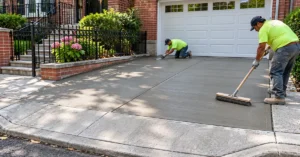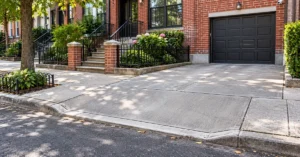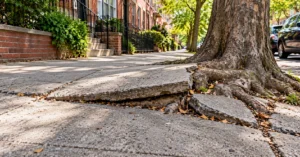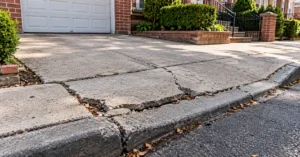
Sidewalk repair in NYC can take one to several working days for straightforward concrete work, while larger projects may require more time. However, the entire process can extend beyond the construction period because contractors must arrange assessments, obtain necessary permits, protect fresh concrete, and complete any required inspections.
For example, replacing a few damaged sidewalk flags may involve relatively limited construction. In contrast, rebuilding a long commercial sidewalk can require additional demolition, preparation, and pedestrian access planning.
Fresh concrete also needs time to gain strength before people can safely walk on it.
If you own property in Brooklyn, Queens, Manhattan, or Staten Island, understanding each stage can help you schedule repairs and avoid unnecessary disruptions.
This guide explains typical sidewalk repair timelines, what can delay construction, and how NYC DOT violation requirements affect the process.
How Long Does Sidewalk Repair Take in NYC?
The time needed for sidewalk repairs depends on the condition of the concrete and the scope of work.
A small repair may take less time than a replacement involving multiple sidewalk flags. However, permit arrangements and site conditions can extend the total project schedule.
Here is a practical overview.
| Type of sidewalk project | General scheduling considerations |
|---|---|
| Minor localized concrete repair | May require a few hours or a working day, depending on the repair method |
| Replacement of a few sidewalk flags | Often involves one or more days of on-site work, plus curing protection |
| Multiple-flag sidewalk replacement | May require several working days depending on demolition, preparation, and concrete placement |
| Extensive sidewalk reconstruction | Can involve a longer construction schedule and additional coordination |
| DOT sidewalk violation repair | Requires the appropriate permit, construction work, and a separate dismissal-inspection process |
These are general expectations rather than guaranteed contractor schedules.
For example, a contractor might complete the physical replacement of a small section within a short period. However, the sidewalk may remain temporarily closed while the fresh concrete gains sufficient strength.
The most important distinction is between construction time, concrete curing time, and the full administrative process.
They are related, but they do not follow one universal schedule.
NYC Sidewalk Repair Timeline: Step by Step
Most sidewalk replacement projects follow several construction stages.
Understanding the sequence can help property owners evaluate estimates and plan around pedestrian access.
Step 1: Sidewalk Inspection and Assessment
First, the contractor examines the damaged sidewalk.
During the inspection, the contractor may identify cracked flags, uneven concrete, settlement, missing sections, or drainage problems.
The assessment also helps determine whether the work requires localized repair or complete replacement of affected flags.
If the property has an NYC DOT sidewalk violation, the contractor should review the Preliminary Inspection Report to identify the sections that require correction.
Time required: A straightforward assessment may take place during one site visit. However, more complex conditions can require additional investigation.
Step 2: Permits and Construction Scheduling
Next, the contractor confirms the necessary approvals and construction arrangements.
NYC DOT generally requires a Sidewalk Construction Permit for regulated sidewalk repair or replacement work.
Permit processing and scheduling depend on the project’s location, scope, and applicable requirements.
Therefore, property owners should not assume that every permit takes a fixed number of business days.
The contractor may also need to coordinate material deliveries, pedestrian protection, and site access.
Time required: Varies according to permit requirements, contractor scheduling, and project conditions.
For official information, review the NYC311 Sidewalk Construction Permit Guide.
Step 3: Remove Damaged Concrete and Prepare the Base
Once the contractor can begin the approved work, the crew removes the damaged concrete.
Depending on the project, preparation may involve:
-
Demolishing defective sidewalk flags
-
Removing concrete debris
-
Excavating unsuitable material where necessary
-
Regrading and compacting the underlying support
-
Establishing appropriate drainage and sidewalk elevations
-
Preparing reinforcement and joints according to the required specifications
The extent of damage affects how long this stage takes.
For example, replacing several ordinary concrete flags may require less preparation than correcting extensive settlement or an unstable base.
Time required: Often a significant portion of the construction schedule, with the duration determined by the area and underlying conditions.
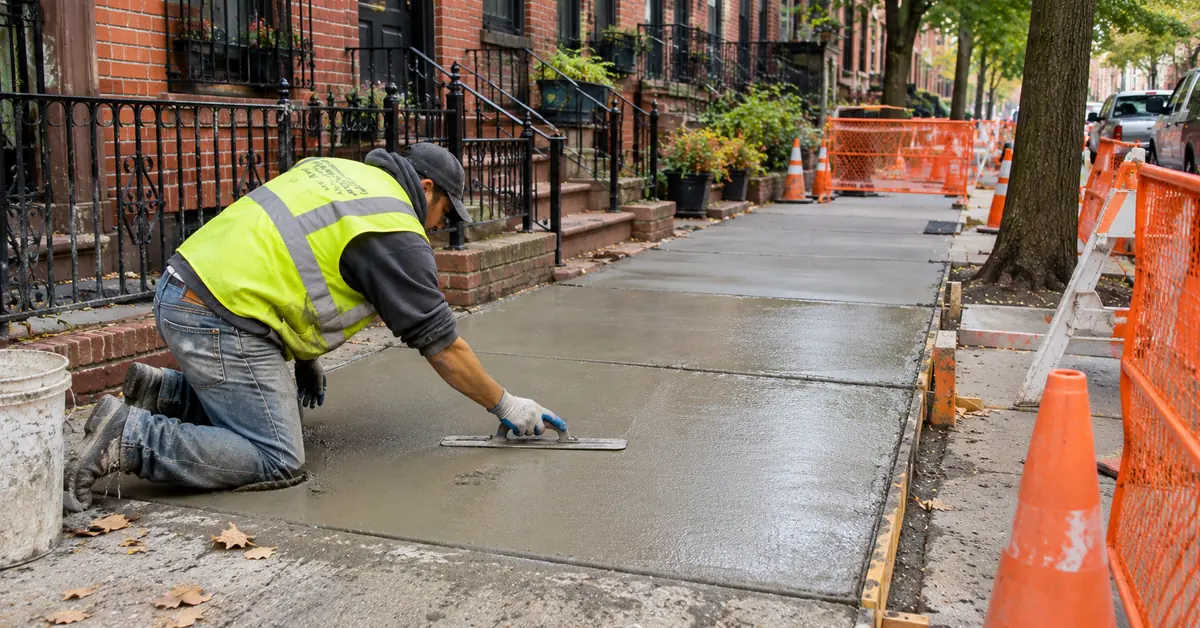
Step 4: Place and Finish the New Concrete
After preparing the site, the crew places concrete according to the project’s specifications.
The contractor then establishes the required elevations, finishes the surface, and completes the necessary joints.
Exterior sidewalks commonly receive a textured finish that provides pedestrian traction.
However, the contractor must follow the applicable NYC DOT requirements rather than use identical details for every property.
The crew also needs to protect freshly placed concrete from premature loading and unsuitable weather exposure.
Time required: Small, straightforward pours may take a working day, while larger or phased projects can require additional time.
Step 5: Protect the Concrete During Curing
Fresh concrete does not reach its intended strength immediately after workers finish the surface.
Instead, cement hydration continues as the material gains strength.
Proper curing helps maintain suitable moisture and temperature conditions during this period.
Therefore, the contractor must protect the concrete according to the mix, weather, and construction specifications.
This stage is especially important when temperatures become unusually hot, cold, or windy.
Time required: The sidewalk’s protection and reopening schedule depends on concrete strength, weather, and applicable project requirements.
Step 6: Complete Any Required DOT Dismissal Inspection
For property owners correcting a DOT sidewalk violation, finishing the physical construction is not the final administrative step.
After completing the repairs, the owner must request a Sidewalk Violation Dismissal Inspection through NYC311.
NYC DOT then checks whether the work meets the applicable requirements.
If the inspector confirms satisfactory repairs, the City can proceed with clearing the violation record.
Time required: Inspection scheduling varies. Property owners should not assume that DOT will complete the dismissal process immediately after the concrete cures.
This inspection is separate from the contractor’s construction schedule.
How Long Before You Can Walk on a Repaired Concrete Sidewalk?
Many conventional concrete sidewalks can support light pedestrian use after approximately 24–48 hours under suitable conditions. However, the contractor must determine the actual reopening time based on the concrete, weather, and applicable specifications.
NYC’s Department of Design and Construction notes that newly poured sidewalks on its projects require a day of curing before use.
Nevertheless, the timing can vary between projects.
For example, cold temperatures can slow concrete strength development. Similarly, some repair materials have specific curing and reopening requirements.
Therefore, pedestrians should not enter a freshly repaired section simply because the surface looks dry.
Does Concrete Take 28 Days to Cure?
Concrete commonly uses 28-day compressive strength as a standard testing and design benchmark.
However, that does not mean every sidewalk must remain closed for 28 days.
Concrete typically gains usable strength well before that benchmark, provided conditions and the material are suitable.
Additionally, the contractor may need to maintain curing protection after the sidewalk has gained enough strength for limited pedestrian access.
Reopening a sidewalk and completing the recommended curing process are not the same thing.
Follow the contractor’s instructions and any applicable project requirements before removing barriers or allowing regular use.
What Can Delay Sidewalk Repair in NYC?
Several conditions can affect the project schedule.
Although a contractor can plan the work carefully, some delays depend on the site and weather.
| Potential delay | Why it matters |
|---|---|
| Permit requirements | The contractor must obtain necessary approvals before regulated work |
| Extensive damaged concrete | More demolition and replacement increase construction time |
| Unstable subbase | Additional excavation and compaction may become necessary |
| Cold or wet weather | Conditions can affect concrete placement and curing |
| Tree-root involvement | Work near City-owned trees may need additional coordination |
| Busy pedestrian areas | Access and protection arrangements may require extra planning |
| Material or equipment availability | Specialized requirements can affect scheduling |
| DOT dismissal inspection | Official violation clearance follows a separate process |
Weather and Concrete Curing
Weather affects both construction scheduling and early concrete strength development.
For example, low temperatures may require protective measures to prevent fresh concrete from freezing.
Meanwhile, hot or windy weather can increase moisture loss from the surface.
Rain can also interfere with certain construction stages.
Therefore, contractors should choose suitable placement conditions and follow appropriate curing practices.
Tree Roots and Underlying Damage
A sidewalk may appear to need only concrete replacement, yet the underlying conditions can complicate the repair.
Tree roots, unstable soil, or drainage problems can affect how contractors prepare the new sidewalk.
Additionally, workers must follow applicable NYC Parks requirements before disturbing City-owned tree roots.
In these situations, a contractor should investigate the cause of the damage rather than simply replace the visible concrete.
How Does a DOT Sidewalk Violation Affect the Timeline?
An NYC DOT sidewalk violation introduces a separate deadline that property owners should understand.
Under NYC DOT guidance, owners generally have a 75-day period after receiving a Notice of Sidewalk Violation to address the required repairs.
The City’s property-owner guide explains that owners arranging private repairs must obtain the required permit and begin the work within that period.
However, obtaining a sidewalk permit does not extend the 75-day deadline.
Does a DOT Sidewalk Violation Carry a Fine?
No. NYC DOT states that a Notice of Sidewalk Violation itself carries no fine.
However, the City may arrange repairs if the owner fails to address the defects under the applicable process.
The Department of Finance can then bill the property owner for the work.
Therefore, postponing necessary repairs can create financial consequences even though the violation itself does not carry a fine.
How Long Does It Take to Remove a Sidewalk Violation?
The full process includes more than concrete construction.
Property owners must arrange the necessary repairs, complete the permitted work, and request a dismissal inspection.
NYC DOT then verifies that the repairs satisfy the requirements.
Because inspection scheduling varies, no contractor can guarantee a universal number of days for official violation removal.
If you have an outstanding notice, review NY Concrete’s Sidewalk Violation Removal Services to learn about the repair process.
For official guidance, visit NYC311 Sidewalk Violation and Repair.
Residential vs. Commercial Sidewalk Repair Timelines
Residential and commercial sidewalk projects follow similar construction principles.
However, project size, pedestrian traffic, property access, and repair conditions can affect scheduling.
For example, a residential property may need only a few concrete flags replaced.
In contrast, a commercial building may have a longer sidewalk frontage or additional access considerations.
Businesses also need to plan around customers, deliveries, and pedestrian circulation.
Consequently, a contractor may recommend phased construction where practical and permitted.
Nevertheless, commercial properties do not automatically require longer curing times solely because they serve businesses.
The concrete specifications and construction conditions determine the necessary protection.
How to Help Your Sidewalk Repair Project Stay on Schedule
Preparation can help reduce avoidable delays.
Before construction begins, take these steps:
-
Document the damaged sections. Photograph cracks, settlement, uneven flags, and other visible defects.
-
Review any DOT violation paperwork. Keep the Notice of Sidewalk Violation and Preliminary Inspection Report available.
-
Request an on-site estimate. Ask the contractor to identify the actual replacement area and construction requirements.
-
Confirm permit responsibilities. Determine who will obtain the necessary approvals.
-
Discuss pedestrian access. Ask how the contractor will protect the work area and maintain suitable access during construction.
-
Confirm the curing plan. Find out when the sidewalk can safely reopen.
-
Understand the inspection process. If the project involves a violation, ask which dismissal steps remain after construction.
Additionally, schedule work early enough to accommodate reasonable weather and availability changes.
However, avoid rushing concrete curing merely to shorten the project.
A properly completed repair is more valuable than an unrealistic completion promise.
Frequently Asked Questions
Can sidewalk repair in NYC be completed in one day?
Some small, straightforward repairs may require only a working day of construction. However, concrete replacement can also involve permits, demolition, curing protection, and additional site preparation.
How long does concrete sidewalk replacement take?
Replacing a few damaged sidewalk flags may involve one or more days of on-site work. Larger replacements can take longer. The contractor should provide a project-specific timeline after inspecting the affected area.
Can I walk on new sidewalk concrete after 24 hours?
Possibly. Some concrete sidewalks can support light pedestrian use after approximately 24–48 hours under suitable conditions. However, the contractor must confirm when the specific repair can safely reopen.
Does NYC require a permit for sidewalk repairs?
NYC DOT generally requires a Sidewalk Construction Permit for regulated sidewalk repair or replacement. Confirm the applicable requirements before work begins.
Does a sidewalk violation give me 75 days to complete repairs?
NYC DOT provides a 75-day compliance period after receipt of a sidewalk violation. Its guidance explains that owners arranging private repairs must obtain the required permit and begin work during that period. A permit does not extend the deadline.
How long does NYC DOT take to remove a sidewalk violation?
After completing the repairs, the owner must request a dismissal inspection. NYC DOT then verifies the work. The timing depends on the agency’s inspection process, so the construction completion date does not guarantee the official removal date.
Can sidewalk repair take longer in winter?
Yes. Cold temperatures, snow, and unsuitable placement conditions can delay concrete work or require additional protection. The contractor must account for weather while following applicable DOT requirements.
Get a Sidewalk Repair Timeline and Free Estimate From NY Concrete
A damaged sidewalk does not always require a long construction project.
However, the repair timeline depends on the condition of the concrete, the required work, permit arrangements, and curing requirements.
NY Concrete provides sidewalk repair and replacement services throughout Brooklyn, Queens, Manhattan, and Staten Island.
Whether your property has uneven concrete flags, cracked sidewalk sections, or an outstanding DOT violation, our team can assess the damage and discuss an appropriate repair scope.
During the estimate process, ask about the expected construction schedule, required approvals, and when the repaired sidewalk can safely reopen.
Explore NYC Sidewalk Repair Services
Request a Free On-Site Estimate
Call NY Concrete: 718-980-8580
For a more complete estimate, share your property’s borough, the approximate damaged area, and any DOT violation information.
Project timelines are illustrative and depend on site conditions, permits, construction specifications, contractor availability, and weather. NYC DOT procedures should be verified against current City guidance before work begins.