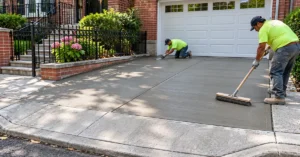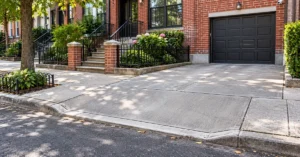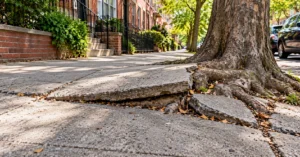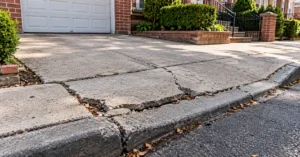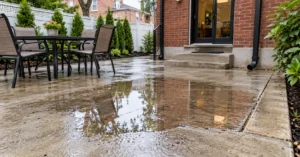
Yes, you can install pavers over old concrete when the existing slab is sound, stable, properly graded and suitable for the proposed installation system. This approach, known as a paver overlay, can improve the appearance of patios, walkways and some driveways without requiring complete demolition.
However, covering damaged concrete with paving stones does not automatically solve problems underneath it.
If the slab is sinking, shifting or collecting water, those conditions may affect the new pavers. In addition, the extra height of a paver installation can create problems near doors, garage entrances and adjacent walkways.
For NYC homeowners, the decision comes down to the concrete’s condition, drainage, available height and intended use.
This guide explains when pavers over concrete make sense, how contractors install them and when removing the old slab provides a better solution.
When Can You Install Pavers Over Existing Concrete?
Before installing pavers over concrete, determine whether the existing surface can provide reliable support.
A concrete patio with minor cosmetic wear may be a suitable candidate. In contrast, a driveway with major settlement, unstable sections or extensive cracking may need repairs or reconstruction first.
Consider these conditions:
| Existing concrete condition | Is a paver overlay suitable? |
|---|---|
| Stable slab with superficial surface wear | Often suitable after proper assessment and preparation |
| Small, non-moving cracks | May be suitable with an appropriate installation system |
| Minor localized damage | Possibly, after correcting the affected area |
| Recurring standing water | Requires drainage correction before installation |
| Significant settlement or shifting | Generally unsuitable until the support problem is resolved |
| Major cracks with vertical displacement | Often requires substantial repair or replacement |
| Insufficient clearance near doors or garages | May need slab modification or an alternative installation |
| Vehicle-loading area | Requires a paver system designed for the actual loads |
These are general guidelines. A contractor should evaluate the existing concrete and surrounding conditions before recommending an overlay.
Does the Concrete Need to Be Perfectly Level?
Not necessarily. Outdoor paving should have an appropriate slope to direct runoff toward a suitable drainage location.
Therefore, the goal is not to create a completely flat surface without pitch.
Instead, the contractor should confirm that the existing concrete has adequate support and that the proposed paver installation will produce suitable finished elevations.
A bedding layer may accommodate minor variations within the system’s requirements. However, it cannot reliably correct significant settlement or major structural movement.
5 Things to Check Before Laying Pavers Over Concrete
A successful overlay depends on more than the appearance of the old slab.
Before beginning installation, check these five conditions.
1. Cracks and Concrete Movement
First, inspect the concrete for cracks, displacement and signs of movement.
Not every crack rules out a paver overlay.
For example, a narrow, stable crack may not create the same concern as a widening crack with one side higher than the other.
However, substantial cracking, movement and heaving may indicate that the existing support is unsuitable.
If the slab continues shifting, new paving stones may develop uneven joints, cracking or other problems.
Therefore, the contractor should evaluate the cause before covering the surface.
2. Drainage Beneath and Around the Pavers
Drainage is one of the most important considerations when installing pavers over concrete.
Water can enter the joints between paving stones.
However, the concrete underneath forms a relatively impermeable surface, so that water needs an appropriate way to escape.
Without adequate drainage, moisture may remain within a sand bedding layer or collect near the slab’s edges.
In NYC, repeated freezing and thawing can create additional concerns when water remains trapped in vulnerable areas.
An effective overlay must account for drainage both above and beneath the pavers.
For certain sand-set systems, the design may include drainage outlets or carefully located weep holes. Contractors should follow the applicable installation specifications rather than drill holes without a suitable drainage plan.
3. Added Height Near Doors and Garages
Installing pavers over concrete raises the finished surface.
The total increase depends on the selected paver thickness and bedding system.
For example, adding paving stones near a garage may affect the transition between the driveway and the garage floor.
Likewise, an overlay beside a patio door can reduce the clearance between the finished paving and the door threshold.
Before installation, measure the available height around:
-
Exterior doors and garage entrances
-
Steps and landings
-
Adjacent walkways
-
Driveway approaches
-
Existing drains
-
Utility access covers
-
Surrounding landscaping
The contractor should also preserve suitable drainage away from buildings.
A decorative upgrade should not create a new trip hazard or direct runoff toward the property.
4. Edge Restraints and Paver Stability
Paver installations need suitable edge support.
For sand-set interlocking pavers, edge restraints help keep the paving units in position and maintain the installation’s intended alignment.
Without appropriate restraints, the units may spread or shift under use.
The installation method and existing concrete conditions determine which edge details will work.
Therefore, contractors should plan the boundaries before placing the pavers.
5. Intended Use: Patio, Walkway or Driveway
A backyard patio and a vehicle driveway do not have the same loading requirements.
For example, a pedestrian patio overlay may use an installation system that would not be appropriate for vehicle traffic.
Driveways require consideration of the existing concrete’s capacity, paver thickness, bedding system, edge support and expected vehicle loads.
In addition, garage approaches and driveway entrances often have limited room for raising the finished surface.
Never assume that a paver system suitable for a patio is automatically suitable for a driveway.
How Do Contractors Install Pavers Over Old Concrete?
Several installation methods can work over existing concrete.
However, the correct method depends on the paving material, application, substrate and manufacturer’s requirements.
Method 1: Sand-Set Pavers Over Concrete
In a sand-set installation, the contractor places a suitable bedding layer between the concrete and the paving stones.
The bedding helps establish the required paver elevations.
However, the installation needs appropriate drainage and edge restraints.
The crew generally follows a sequence that includes:
-
Inspecting the existing concrete for stability and damage.
-
Confirming suitable elevations and drainage.
-
Repairing defects that affect the overlay.
-
Installing the specified bedding layer.
-
Placing the pavers in the selected pattern.
-
Installing and maintaining the required edge restraints.
-
Compacting and filling the joints according to the paver system.
The actual sequence and materials depend on the manufacturer’s specifications.
Important: A sand bedding layer should not trap water over the existing slab.
The Concrete Masonry & Hardscapes Association provides technical specifications for interlocking concrete paver overlays that address bedding materials, drainage and construction requirements.
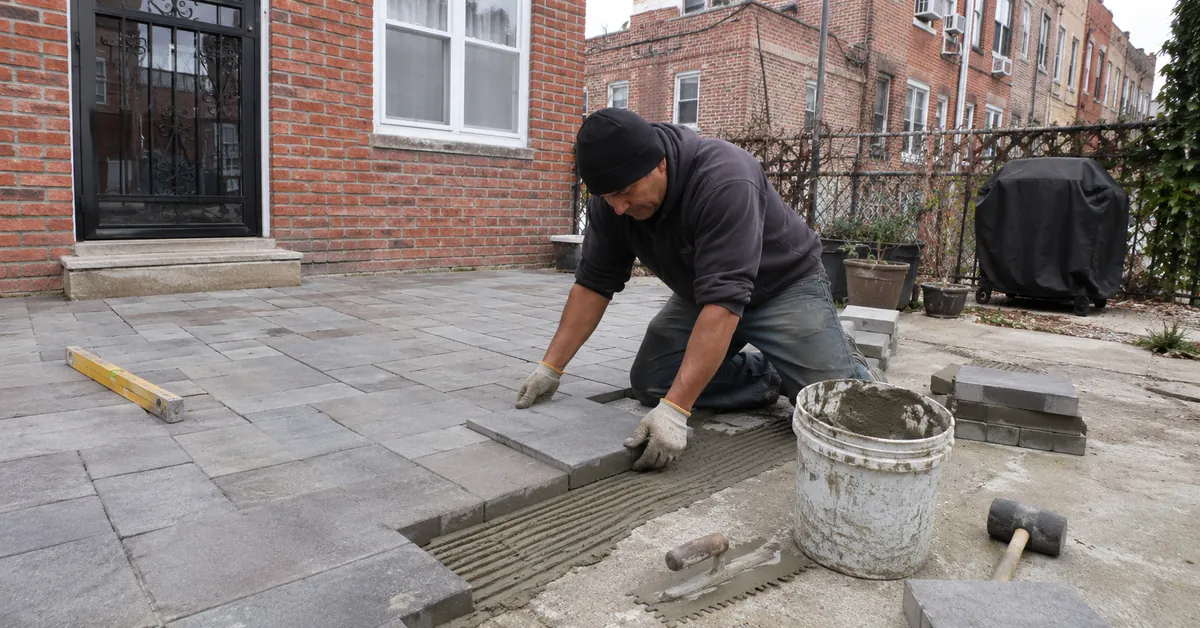
Method 2: Mortar-Set Pavers Over Concrete
A mortar-set installation uses a compatible cementitious setting system to bond suitable paving units to the concrete.
Contractors may use this approach for certain patios, walkways and other applications where an adhered assembly is appropriate.
However, the concrete must provide a suitable substrate.
Before laying the paving stones, the crew may need to remove contamination, repair unsound areas and prepare the surface according to the selected mortar system.
The installation must also address drainage, movement joints and environmental exposure.
For example, existing movement joints may require corresponding treatment in the finished paving rather than being covered without consideration.
Mortar-set pavers should not automatically be treated as a universal solution for vehicle driveways.
The system must suit the intended loading and application.
Method 3: Specialized Thin-Paver Overlay Systems
Some manufacturers offer thinner concrete or porcelain pavers specifically designed for overlay applications.
These materials can reduce the total height increase compared with certain conventional paver systems.
However, their suitability depends on the approved installation method.
For example, some porcelain pavers can use compatible exterior bonding systems over sound concrete.
Other products may require different bedding, spacers, joints or drainage details.
Consequently, contractors should select both the paver and its complete installation system before beginning work.
Do not assume that ordinary indoor tile adhesive or a generic mortar mix is suitable for an exterior concrete overlay.
Pavers Over Concrete vs. Removing and Replacing the Slab
Should you install pavers over the existing concrete or remove it and prepare a new base?
The answer depends on the condition of the slab and the proposed paving design.
| Factor | Install pavers over concrete | Remove concrete and rebuild |
|---|---|---|
| Existing slab | Must be suitable for the overlay | Allows removal of unsuitable concrete |
| Demolition | May reduce demolition work | Requires concrete removal and disposal |
| Finished height | Raises the existing surface | Allows greater control over final elevations |
| Drainage | Requires careful planning over the slab | Allows redesign of the underlying drainage and base |
| Base problems | Cannot simply cover unresolved movement | Provides access to correct underlying conditions |
| Construction scope | May be smaller when the slab is sound | Generally involves more preparation |
| Long-term performance | Depends on the overlay and existing support | Depends on the newly constructed system |
When Does an Overlay Make More Sense?
An overlay may be practical when the existing concrete remains stable, drainage can be managed and the added height will not interfere with surrounding features.
For example, an aging backyard patio may have a sound slab but an outdated appearance.
In that situation, a compatible paver overlay could improve the outdoor space without removing all the concrete.
When Is Concrete Removal the Better Choice?
Removal may be preferable when the existing concrete has widespread settlement, major damage or unsuitable grading.
For example, if several driveway sections continue sinking, an overlay may hide the visible damage temporarily without correcting the underlying problem.
Reconstructing the affected area can provide an opportunity to correct the base, drainage and finished elevations.
Therefore, the contractor should compare the actual work required rather than recommend an overlay simply because demolition costs more.
What Are the Benefits and Drawbacks of Pavers Over Concrete?
Installing pavers over an existing slab can offer useful advantages.
However, it also introduces design limitations.
Potential Benefits
Less demolition: When the original concrete remains suitable, the project may avoid extensive removal and debris disposal.
Improved appearance: Paving stones offer different patterns, colors and finishes for patios and walkways.
Possible time savings: Reusing a sound existing slab can reduce some construction stages.
Design flexibility: Depending on the installation system, homeowners may choose concrete, brick or other suitable paving units.
Potential cost savings: Avoiding major demolition and base reconstruction may reduce costs, although the final total depends on the project.
Potential Drawbacks
Increased surface height: The new paver and bedding layers can interfere with entrances, steps and adjoining surfaces.
Drainage challenges: Water may become trapped between the pavers and the underlying concrete without an appropriate drainage system.
Existing defects remain: A paver overlay does not automatically correct settlement or unstable support.
Installation restrictions: Some paving materials and setting systems are suitable only for particular applications.
Future repair complexity: Accessing an underlying slab may require removing part of the paver installation.
As a result, the best choice depends on the condition of the property rather than appearance alone.
Can You Install Pavers Over a Concrete Driveway?
Yes, certain paver systems can be installed over an existing concrete driveway when the slab and complete installation design can support vehicle traffic.
However, driveways require additional evaluation.
The contractor should consider vehicle weights, the condition of the existing slab, paver thickness, edge restraints and transitions near the garage.
For example, a driveway with extensive cracks or uneven settlement may not provide suitable support.
Likewise, an overlay that raises the driveway too close to the garage threshold may create drainage or clearance problems.
Some manufacturers provide systems specifically intended for vehicular concrete overlays.
Therefore, use an installation method supported by the paving manufacturer’s technical requirements rather than applying a pedestrian patio method to a driveway.
Can You Install Pavers Over an Old Concrete Patio?
A ground-level concrete patio is often a more straightforward overlay candidate than a heavily loaded driveway.
However, the slab must still be stable, suitably graded and compatible with the selected installation method.
For example, a sound concrete patio may support a suitable paver system when the contractor provides proper drainage and edge support.
Before installation, also check how the additional surface height affects doors, steps and adjoining landscaping.
For homeowners planning a backyard upgrade, explore Paver Patio Installation NYC.
Does NYC Allow Pavers Over Existing Public Sidewalks?
Private patios, walkways and driveways differ from public sidewalks.
NYC DOT regulates construction within the public right-of-way, including applicable sidewalk repairs and alterations.
Furthermore, the City has specific requirements for sidewalk materials.
If a property owner wants to use distinctive or nonstandard materials instead of conventional sidewalk concrete, additional reviews or approvals may apply.
Therefore, do not assume that installing decorative pavers over an existing public concrete sidewalk is automatically permitted.
Landmarked properties and historic districts may involve further requirements.
Before modifying a public sidewalk, review the applicable DOT rules, permits and sidewalk material standards.
For official information, visit the NYC DOT Sidewalk Program.
How Much Does It Cost to Install Pavers Over Concrete?
The cost depends on the existing slab, paving material, installation method and project conditions.
An overlay may cost less than demolition and complete reconstruction when the existing concrete needs little preparation.
However, substantial repairs or drainage improvements can reduce that advantage.
Important cost factors include the paver type, square footage, bedding materials, labor, edge restraints, preparation, access and required approvals.
For example, thin decorative pavers over a sound backyard patio may involve a different scope from vehicle-rated pavers over a driveway.
Therefore, a contractor should inspect the property before estimating the complete installation.
Avoid comparing only the paver material cost. The underlying preparation and finished drainage system matter just as much.
How to Maintain Pavers Installed Over Concrete
Proper maintenance can help preserve the appearance and usability of an overlay.
Start by sweeping dirt and debris from the surface regularly.
Additionally, check for recurring water pooling, loose joints and changes in paver elevation.
Some installations may require joint-material maintenance or compatible protective treatments.
However, sealing is not mandatory for every paver product, and the wrong sealer can affect appearance or surface traction.
Always follow the relevant product recommendations.
If individual pavers become loose or uneven, investigate the cause before resetting them.
For further guidance, read How to Repair Uneven Pavers Before They Become Unsafe.
Frequently Asked Questions About Installing Pavers Over Concrete
Can you install pavers directly over concrete?
Yes, some pavers can be installed over a sound concrete slab using a suitable sand-set, mortar-set or specialized overlay system. However, the installation must account for drainage, surface height, stability and the manufacturer’s requirements.
Is it better to remove old concrete before installing pavers?
Not always. If the concrete remains stable and the overlay can meet the project’s requirements, removal may be unnecessary. However, severely damaged or moving concrete may need replacement before new paving work.
Can pavers go over cracked concrete?
Possibly. Minor, stable cracks may be acceptable for certain systems. However, significant cracks with movement, heaving or settlement can compromise the overlay and should be evaluated before installation.
Do you need sand under pavers installed over concrete?
Not every system uses sand. Some installations use a suitable sand bedding layer, while others rely on compatible mortar or specialized bonding systems. The correct choice depends on the paver type and application.
Will water get trapped beneath pavers over concrete?
It can if the system lacks appropriate drainage. Water may enter through paver joints and collect above the underlying slab. Therefore, contractors must design a suitable drainage path.
Can you put pavers over a concrete driveway?
Yes, when the existing slab is suitable and the selected overlay system supports vehicle traffic. However, driveway installations require additional consideration of loading, paver thickness, edge restraints and garage transitions.
How much height do pavers add over concrete?
The height increase depends on the paving unit and setting-bed thickness. Some thin-overlay systems add less height than conventional pavers. The contractor should calculate the complete finished elevation before installation.
Can you install porcelain pavers over old concrete?
Yes, certain porcelain paver systems can be installed over a sound concrete substrate. However, exterior bonding materials, movement joints, drainage and the manufacturer’s specific instructions are essential.
Need Paver Installation Over Existing Concrete in NYC?
Installing pavers over old concrete can be a practical way to improve a patio, walkway or driveway.
However, the existing slab must provide suitable support, and the installation must address drainage, surface height and intended use.
NY Concrete provides paver installation, repair and replacement services throughout Brooklyn, Queens, Manhattan and Staten Island.
Our team can review your existing concrete and discuss whether a paver overlay or a new installation would better suit the property.
Explore our services:
Request a free on-site estimate from NY Concrete.
Contact NY Concrete or call 718-980-8580.
When requesting an estimate, share your borough, approximate paving area and whether the existing concrete has cracks, settlement or drainage problems.