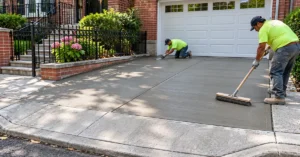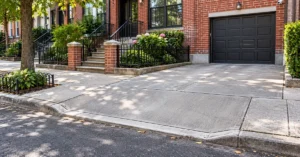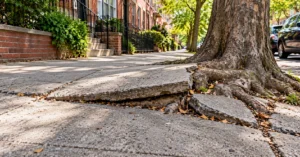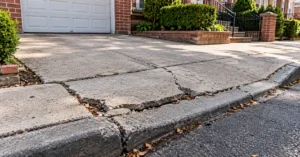
The best concrete for sidewalks is a properly specified, durable concrete mix that can withstand pedestrian traffic, moisture, and New York City’s freezing and thawing conditions. For public sidewalk construction, contractors must follow the applicable NYC Department of Transportation (DOT) specifications rather than simply choose the highest-strength concrete available.
NYC DOT’s published highway specifications identify Class B-32 concrete for standard sidewalk construction unless the approved project documents specify otherwise. This class has a minimum 28-day compressive strength of 3,200 PSI. Other approved concrete classes, including 4,000 PSI mixes, may apply to particular projects.
However, strength alone does not determine sidewalk durability. Air entrainment, concrete thickness, base preparation, drainage, joint placement, finishing, and curing all play important roles.
Whether you’re replacing cracked sidewalk flags in Brooklyn or installing a concrete walkway in Queens, understanding these factors can help you evaluate the contractor’s proposed materials and construction methods.
What Concrete Mix Should Be Used for Sidewalks?
Most conventional sidewalks use Portland-cement-based concrete containing cementitious materials, water, fine aggregate, and coarse aggregate.
The proportions and material properties determine the concrete’s strength, workability, and durability.
For NYC public sidewalks, contractors must follow the applicable DOT mix classifications and approved construction specifications.
Understanding Concrete Strength: 3,200 PSI vs. 4,000 PSI
Concrete compressive strength is commonly expressed in pounds per square inch, or PSI.
Higher PSI indicates greater measured compressive strength. However, it does not automatically mean the concrete will resist every type of deterioration more effectively.
NYC DOT’s published specifications include several concrete classes.
| Concrete class | Minimum 28-day strength | What property owners should know |
|---|---|---|
| B-32 | 3,200 PSI | Identified in published DOT specifications for conventional sidewalk construction unless otherwise specified |
| A-40 | 4,000 PSI | A higher-strength class used where the approved project requirements call for it |
| High Early Strength (HE) | 4,000 PSI | Designed to achieve specified early strength for suitable construction applications |
These classifications come from NYC DOT’s highway specifications. They are not interchangeable options that property owners should select solely according to price.
For example, 4,000 PSI concrete may be suitable for a particular sidewalk replacement project. However, that does not establish a universal requirement for every NYC sidewalk.
The correct concrete mix is the one that satisfies the applicable specifications and the project’s actual conditions.
Why Air-Entrained Concrete Matters in NYC
New York City’s winters create challenging conditions for exposed concrete.
Rainwater, snowmelt, freezing temperatures, and deicing chemicals can contribute to surface deterioration.
Fortunately, properly designed air-entrained concrete can improve resistance to freeze-thaw damage.
Air entrainment introduces numerous small, distributed air bubbles into the concrete mixture.
When moisture inside the hardened concrete freezes, these air spaces help accommodate internal pressure.
As a result, the concrete becomes better equipped to resist certain forms of freeze-thaw deterioration.
The American Concrete Institute identifies air entrainment as an important method of improving resistance to freezing, thawing, and deicing-related scaling.
However, air entrainment cannot compensate for every construction problem.
Poor curing, excessive mixing water, unstable support, or recurring moisture exposure can still affect the sidewalk.
Therefore, contractors should evaluate the complete concrete specification rather than concentrate on one ingredient.
For more information about surface deterioration, read Why Concrete Surfaces Flake and How to Prevent It.
How Thick Should a Concrete Sidewalk Be in NYC?
NYC DOT’s standard sidewalk details distinguish ordinary pedestrian areas from driveway crossings and corner quadrants.
Published standard specifications identify a 4-inch concrete thickness for conventional sidewalk areas and 7 inches in driveway crossings and corner quadrants, unless the approved specifications require otherwise.
The standard section also identifies a 6-inch foundation layer beneath the concrete, subject to the applicable design.
| Sidewalk location | Published standard concrete thickness |
|---|---|
| Ordinary pedestrian sidewalk | 4 inches |
| Sidewalk through a driveway crossing | 7 inches |
| Corner quadrant | 7 inches |
| Special construction conditions | Follow the approved design and specifications |
These figures describe NYC DOT’s published standard sidewalk construction requirements. Other approved project conditions may require different details.
Why Are Driveway Crossings Different?
A normal sidewalk primarily accommodates pedestrians.
However, a driveway crossing also experiences vehicle loads when cars or trucks enter and leave the property.
Consequently, the concrete section must meet the requirements for that use.
Additional considerations can include the supporting foundation, joint layout, access design, and connection to surrounding sidewalk flags.
A contractor should not assume that a residential driveway crossing can use the same section as an ordinary pedestrian sidewalk.
Does Sidewalk Concrete Need Wire Mesh or Reinforcement?
Not every sidewalk automatically requires the same reinforcement.
Steel reinforcement, welded wire fabric, or other approved materials may form part of a project’s construction specifications.
However, reinforcement is not a substitute for proper base preparation, drainage, joints, or curing.
Steel reinforcement can help control crack width and support the intended performance of appropriately designed concrete sections.
Nevertheless, reinforcement does not guarantee that a sidewalk will never crack.
Concrete naturally experiences shrinkage and temperature-related movement.
Contractors use appropriate joint placement and curing practices to manage these effects.
What About Fiberglass Reinforcement?
Some concrete mixtures contain fibers that can help manage certain forms of cracking.
However, fibers do not automatically replace specified steel reinforcement or welded wire fabric.
The project requirements determine which materials are appropriate.
For example, if an approved plan requires a particular reinforcement system, the contractor should not substitute another material without the necessary approval.
Before construction begins, ask the contractor to explain which reinforcement the project requires and why.
What Makes a Concrete Sidewalk Durable?
Concrete strength matters, but long-term performance depends on several connected factors.
Proper Base Preparation
A concrete sidewalk needs suitable support underneath it.
If the soil or foundation material lacks adequate stability, the finished concrete may settle unevenly.
This movement can contribute to cracks, height differences, or damaged sidewalk flags.
Therefore, contractors should inspect and prepare the underlying support before placing new concrete.
Depending on the conditions and specifications, the work may involve removing unsuitable material, establishing the required foundation, and compacting the base.
Correct Water Content
Water helps cementitious materials react and allows workers to place the concrete.
However, excessive water can increase porosity and reduce the strength or durability of the hardened material.
Adding water merely to make finishing easier may also weaken the surface.
Instead, contractors should use a mixture that meets the approved proportions and placement requirements.
Appropriate Joint Placement
Concrete expands, contracts, and shrinks as conditions change.
Joints help accommodate movement and control where cracking occurs.
NYC DOT specifies appropriate joint methods for sidewalk construction, including standard tooled joints and approved saw-cut arrangements.
Contractors must also install the required expansion-joint materials at applicable locations.
However, joints cannot correct major soil movement or an unstable foundation.
Suitable Surface Finishing
Sidewalks need a walking surface that meets the applicable pedestrian traction and construction requirements.
An excessively smooth finish can become slippery when wet.
At the same time, poor finishing techniques can weaken the upper surface and contribute to scaling or peeling.
Therefore, contractors should follow the specified finishing method instead of treating a highly polished appearance as the goal.
Proper Concrete Curing
Concrete continues developing strength after workers place and finish it.
Curing helps maintain suitable moisture and temperature conditions during early strength development.
If concrete dries too rapidly or freezes before developing sufficient strength, deterioration may follow.
Consequently, contractors should protect newly placed sidewalk concrete from unsuitable weather and premature loading.
The required protection and reopening schedule depends on the concrete mixture, environmental conditions, and project specifications.
How Do Contractors Install a Concrete Sidewalk Properly?
A durable sidewalk begins with the correct construction sequence.
Although individual projects vary, a concrete sidewalk replacement may involve the following steps.
1. Inspect the Existing Sidewalk
First, the contractor examines the damaged sections and determines which flags need repair or replacement.
The inspection may identify cracked concrete, settlement, improper slopes, and underlying support problems.
If NYC DOT issued a sidewalk violation, the contractor should also review the Preliminary Inspection Report.
2. Obtain the Necessary Permits
Next, the contractor confirms the applicable construction requirements.
NYC DOT generally requires permits for regulated sidewalk repair and replacement work, subject to limited exceptions.
Therefore, property owners should confirm the permit arrangements before construction begins.
3. Remove Damaged Concrete
The crew removes the specified damaged sections and disposes of the debris.
Workers should also protect adjacent property features and avoid unnecessary damage to sound sidewalk sections.
4. Prepare the Supporting Foundation
After removing the damaged concrete, the contractor examines the underlying support.
The crew then prepares the foundation according to the approved specifications.
This may include excavation, grading, and compaction.
If unstable ground or recurring drainage problems contributed to the original damage, the repair should address those conditions.
5. Install Forms, Joints, and Required Reinforcement
Next, workers establish the proposed sidewalk elevations and repair boundaries.
They also prepare the required joints and install reinforcement where the project specifications call for it.
This preparation helps establish the appropriate layout before concrete placement.
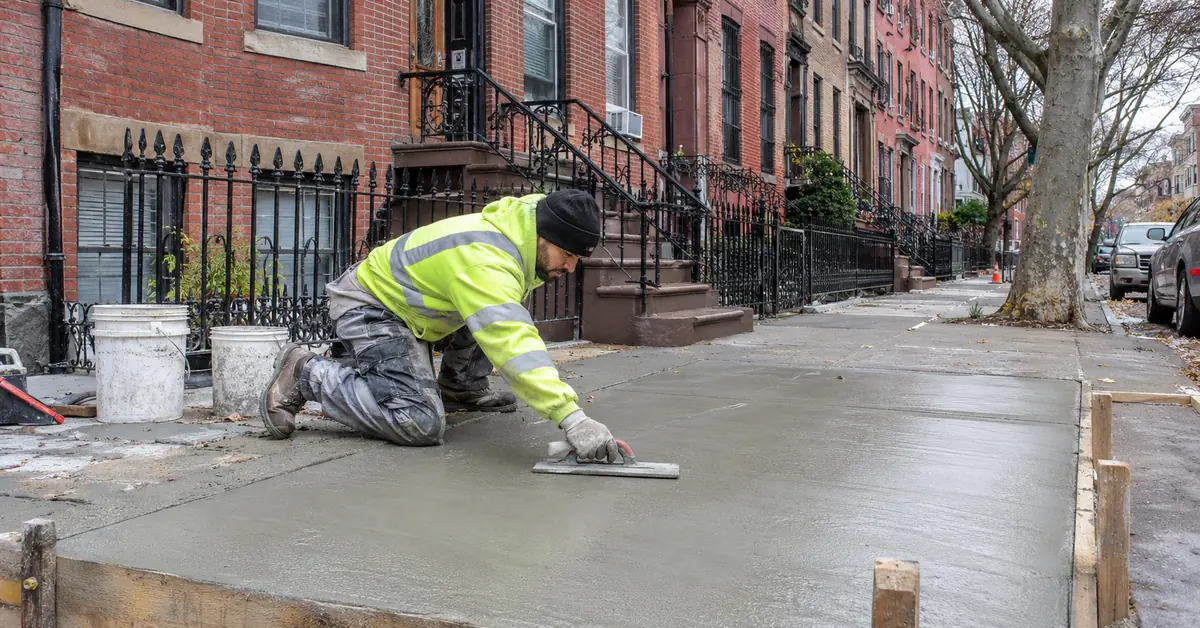
6. Place and Finish the Concrete
The crew places the approved concrete mixture at the required thickness.
Workers then establish the specified surface elevations and finish.
Proper workmanship helps maintain consistent drainage, pedestrian usability, and appearance.
7. Cure and Protect the New Concrete
Finally, the contractor protects the freshly placed concrete while it develops sufficient strength.
The sidewalk should remain protected from premature use and unsuitable environmental conditions.
For work involving a DOT violation, the owner must also complete the applicable dismissal-inspection process after the required repairs.
For additional information about construction scheduling, read How Long Does Sidewalk Repair Take in NYC?.
Common Concrete Sidewalk Installation Mistakes
Even a suitable concrete mixture can perform poorly when the installation has serious deficiencies.
Here are some problems worth avoiding.
Choosing concrete based only on PSI: High compressive strength cannot correct poor drainage, unstable soil, or improper curing.
Skipping foundation preparation: Weak or uneven support can allow concrete flags to settle or crack.
Adding too much water: Excess water can compromise concrete performance and weaken the finished surface.
Using unsuitable joint details: Improper joint construction may contribute to uncontrolled cracking.
Finishing the surface incorrectly: Poor finishing can damage the surface layer and affect pedestrian traction.
Ignoring weather conditions: Fresh concrete needs appropriate protection during cold, hot, windy, or wet conditions.
Using incorrect sidewalk thickness: Driveway crossings and corner quadrants may require different construction sections from ordinary pedestrian areas.
Instead, contractors should follow the applicable NYC DOT requirements and evaluate the property’s specific conditions.
Does NYC Require Special Concrete for Sidewalk Repairs?
NYC DOT regulates public sidewalk construction and publishes specifications for concrete materials, thickness, foundations, and joints.
In addition, certain commercial zoning districts require pigmented sidewalk concrete.
Special conditions can also apply near street trees, utility structures, curb ramps, and other public infrastructure.
Therefore, property owners should not assume that one generic sidewalk concrete mixture and finish will meet every NYC requirement.
When arranging a repair, ask the contractor to identify the applicable specifications and explain the materials included in the estimate.
Official resources include:
Frequently Asked Questions About Sidewalk Concrete
What is the best concrete for sidewalks?
The best concrete is a durable, properly specified mixture suited to the expected loads, weather exposure, and construction requirements. NYC DOT’s published specifications identify Class B-32 for conventional sidewalk work unless other requirements apply.
Is 3,000 PSI or 4,000 PSI concrete better for sidewalks?
A higher compressive strength is not automatically the best choice. The approved mix must meet the applicable minimum strength and durability requirements. NYC DOT identifies specific concrete classes for sidewalk construction, including B-32 and higher-strength classes where specified.
Does a concrete sidewalk need reinforcement?
Not every sidewalk requires identical reinforcement. The approved project details determine whether steel mesh, other reinforcement, or a particular concrete section is necessary. Proper joints, foundation preparation, and curing remain important regardless.
How thick should sidewalk concrete be in NYC?
NYC DOT’s published standard details identify 4 inches for ordinary sidewalk areas and 7 inches for driveway crossings and corner quadrants, unless another approved specification applies.
Why is air-entrained concrete useful for sidewalks?
Air entrainment improves concrete resistance to repeated freezing and thawing, especially when the material becomes saturated. It can also help reduce certain types of scaling associated with winter exposure and deicing chemicals.
Can 4,000 PSI concrete prevent sidewalk cracks?
No. Although 4,000 PSI concrete provides higher specified compressive strength than lower-strength mixes, cracking can still result from shrinkage, settlement, temperature changes, loading, or improper construction.
What finish is appropriate for an NYC sidewalk?
The finish must meet the applicable NYC DOT requirements for that project. Suitable surface texture, proper elevations, and joint details matter more than creating a highly polished appearance.
Can I use regular bagged concrete to replace a public sidewalk flag?
Do not assume that a generic bagged concrete product meets NYC DOT specifications. Public sidewalk replacement requires the applicable concrete classification, construction details, and permits. Confirm the required materials before beginning work.
Need Concrete Sidewalk Repair or Replacement in NYC?
Choosing the right concrete mixture is only one part of building a durable sidewalk.
The supporting foundation, proper thickness, drainage, joints, and curing all influence the finished result.
NY Concrete provides sidewalk repair and replacement services throughout Brooklyn, Queens, Manhattan, and Staten Island.
Whether your property has cracked concrete flags, uneven sections, deteriorating surfaces, or a DOT sidewalk violation, our team can review the required work and discuss the appropriate repair scope.
Explore our services:
Request a free on-site sidewalk estimate.
Contact NY Concrete or call 718-980-8580.
When requesting an estimate, provide your property’s borough, the approximate damaged area, and any DOT inspection or violation information available.
Concrete specifications vary according to the project and applicable regulations. Confirm the current NYC DOT requirements and approved construction details before beginning regulated sidewalk work.