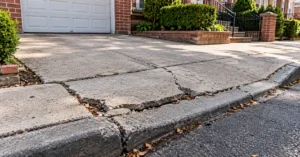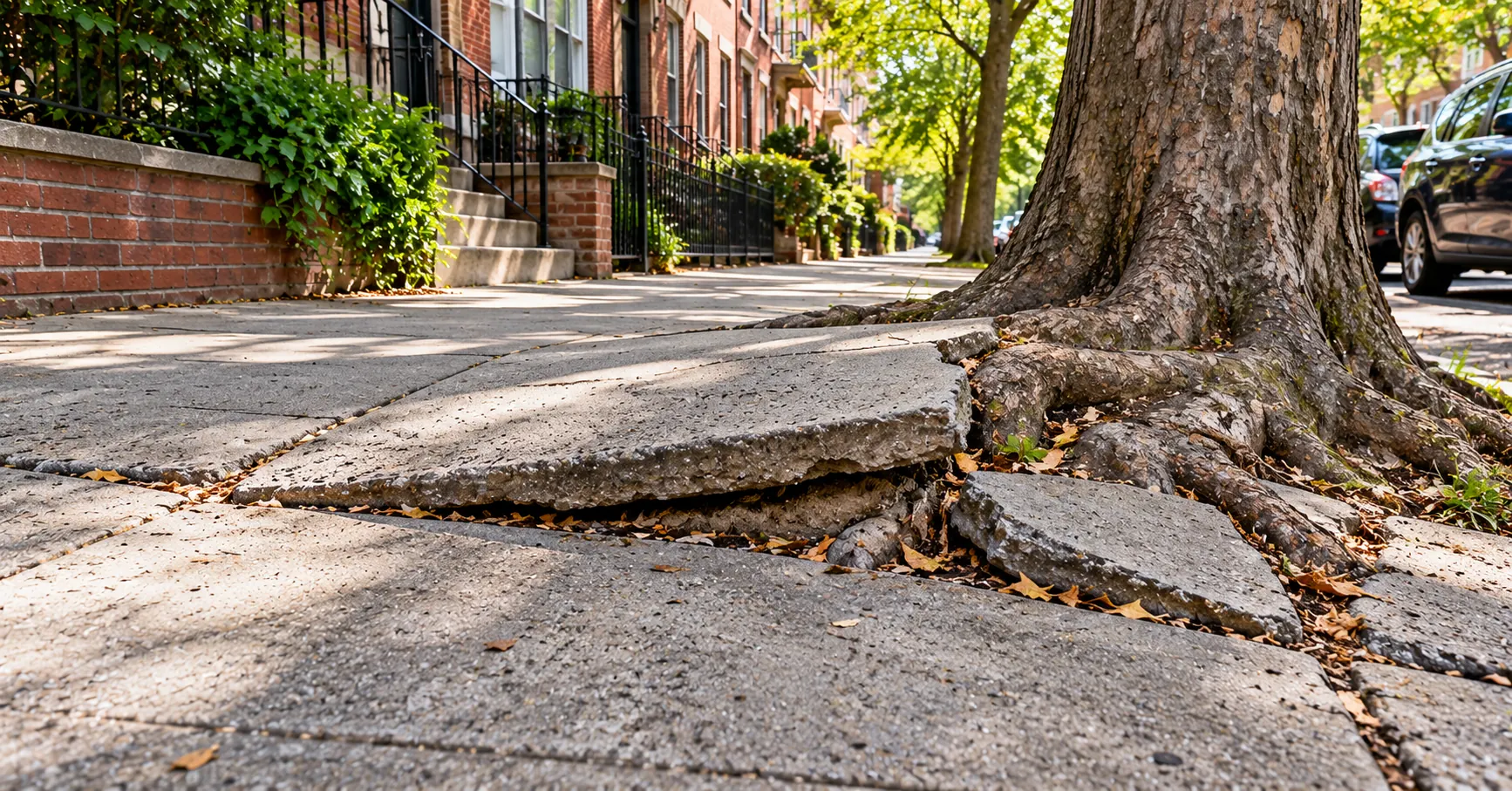
A raised concrete sidewalk near a street tree is a common sight in New York City. What starts as a small uneven section can eventually become a noticeable trip hazard.
You may see a slab lifting near the tree pit, cracks spreading across the concrete, or a sidewalk section leaning toward the street.
The natural assumption is that the property owner must pay for repairs.
However, NYC has special rules for sidewalk damage caused by City-owned trees. Some residential properties may qualify for free repairs through the NYC Parks Trees and Sidewalks Repair Program.
The challenge is understanding who is responsible, whether the sidewalk qualifies, and how repairs can be completed without damaging the tree.
Quick Answer: Who Pays for Sidewalk Damage Caused by Tree Roots in NYC?
NYC generally requires adjoining property owners to maintain their sidewalks. However, the City provides special protections for qualifying one-, two-, and three-family properties with damage caused by City-owned trees.
Eligible properties may receive free sidewalk repairs through the NYC Parks Trees and Sidewalks Repair Program.
Owners of larger residential properties, commercial buildings, and other properties may have different responsibilities.
An official inspection determines eligibility. Property owners should confirm the source of the damage before arranging repairs.
Why Tree Roots Lift Concrete Sidewalks
Tree roots grow outward in search of water, oxygen, and suitable soil conditions.
Many street trees grow in relatively confined spaces between sidewalks and roadways.
As roots increase in size, they can place pressure on nearby concrete or contribute to movement beneath sidewalk slabs.
Over time, the concrete may begin lifting or shifting.
The damage often appears near the tree pit, but roots can extend farther beneath surrounding sidewalk sections.
Several factors influence the severity of the problem, including tree species, age, soil conditions, available growing space, and the sidewalk’s construction.
Not every uneven slab near a tree results from root growth. Settlement, drainage problems, and deterioration can produce similar symptoms.
That is why identifying the actual cause matters.
Warning Signs of Tree-Related Sidewalk Damage
Tree root damage often develops gradually.
You may notice one sidewalk flag rising above the next. Small cracks can spread across the surface, and joints may begin separating.
In more advanced cases, the concrete can fracture into uneven sections.
These conditions may create tripping hazards for pedestrians, particularly where the elevation changes abruptly.
Other signs include restricted tree pits, concrete pressing against the tree trunk, and recurring cracks after previous sidewalk repairs.
A raised slab deserves attention even when the concrete itself looks relatively strong.
The problem may involve movement beneath the surface rather than deterioration of the concrete mixture.
Does NYC Repair Sidewalks Damaged by City Trees for Free?
In certain circumstances, yes.
The NYC Parks Trees and Sidewalks Repair Program offers free repairs for qualifying sidewalks damaged by the roots of City-owned curbside trees.
The program applies to eligible sidewalks adjoining one-, two-, and three-family residential properties.
An official inspection determines whether the location qualifies.
NYC considers factors such as the severity of damage and the condition of the tree when prioritizing repair work.
Property owners should not assume that submitting a request guarantees immediate construction.
The program has eligibility requirements and repair priorities.
To learn about the application process, consult the official NYC311 Trees and Sidewalks Repair guidance.
What About Four-Family Buildings and Commercial Properties?
Responsibilities can differ for larger properties.
According to NYC311, sidewalk defects caused by tree roots adjoining buildings with four or more residential units, commercial properties, and vacant lots generally remain the responsibility of the property owner.
These properties do not receive the same protections provided to qualifying one-, two-, and three-family homes.
This distinction matters in NYC, where properties can look similar from the street but have different legal classifications.
A small apartment building, mixed-use property, or commercial storefront may face obligations that differ from those of a qualifying owner of a smaller residential building.
Before planning repairs, confirm your property’s classification and the relevant sidewalk requirements.
Can You Cut Tree Roots to Level the Sidewalk?
Property owners should never assume that cutting roots is an acceptable way to repair raised concrete.
Roots help support the tree and supply water and nutrients.
Removing important roots can damage the tree and potentially affect its stability.
NYC restricts root cutting and pruning involving City-owned street trees.
The City provides professional consultation for sidewalk work around street trees.
A repair contractor should coordinate with the appropriate agency before performing excavation that could affect protected roots.
Never instruct a crew to cut or shave roots simply to make room for a replacement concrete slab.
The repair should protect both pedestrian access and tree health.
How Can a Sidewalk Be Repaired Without Damaging the Tree?
The correct method depends on the sidewalk condition, available space, root locations, and applicable NYC requirements.
A contractor or authorized specialist may evaluate whether the sidewalk layout can accommodate the existing roots.
Possible approaches can involve modifying the tree pit, adjusting the sidewalk design, or using approved construction methods around the root area.
Not every approach works at every site.
Concrete replacement may be necessary when slabs have fractured or shifted significantly.
However, removing and replacing the concrete without accounting for the tree roots could allow similar damage to return.
An effective repair considers both the sidewalk surface and the living tree beneath or beside it.
What If You Already Received a DOT Sidewalk Violation?
Receiving a sidewalk violation can make tree-related damage more confusing.
NYC DOT generally requires property owners to correct qualifying sidewalk defects.
However, the City treats damage caused solely by City-owned trees differently for qualifying one-, two-, and three-family properties.
NYC DOT states that it no longer issues sidewalk violations to those qualifying properties for defects caused exclusively by City trees.
If you have an existing notice, review the violation report and contact the appropriate City agency to confirm whether the damage qualifies for special treatment.
Do not assume that every violation near a tree will automatically be canceled.
Other damaged sections may remain the owner’s responsibility.
It is important to distinguish tree-related defects from unrelated cracking, settlement, or deterioration.
What If You Want to Hire a Private Contractor?
Property owners may choose private repairs rather than relying on a City program, particularly when the property does not qualify or the project requires a different schedule.
However, the work must follow the applicable NYC DOT and NYC Parks requirements.
A qualified contractor should identify the affected sidewalk flags, assess the concrete condition, and determine which permits or agency consultations are necessary.
If the project involves City-owned tree roots, the repair plan must respect the tree-protection rules.
The contractor should also explain the proposed concrete work, including removal, preparation, placement, finishing, and cleanup.
For general concrete sidewalk repairs, NY Concrete offers sidewalk repair services in NYC for residential and commercial properties.
When street trees are involved, property owners should first confirm the applicable NYC Parks requirements and available City assistance.
How Much Does Tree Root Sidewalk Repair Cost?
Costs depend on the property, repair responsibilities, and whether the site qualifies for City-funded work.
Eligible repairs through the Trees and Sidewalks Repair Program may be completed at no charge to qualifying property owners.
For private repairs, the cost depends on the amount of damaged concrete, site access, permits, base preparation, and any approved work around existing roots.
Replacing several damaged sidewalk flags generally involves more work than correcting a limited section.
Special tree-protection requirements can also affect the construction process.
Before comparing estimates, confirm whether the City may cover the work.
Paying privately without checking eligibility could mean overlooking an available assistance program.
Why This Problem Matters Across NYC
Tree-lined streets are part of the character of many New York City neighborhoods.
In Brooklyn and Queens, mature street trees often grow beside residential sidewalks and older masonry properties.
Manhattan streets may have constrained tree pits and heavy pedestrian traffic.
Staten Island neighborhoods also contain mature trees near residential walkways and public sidewalks.
Each location presents different site conditions.
A sidewalk beside a small tree pit may require a different approach from one near a large, established tree with extensive roots.
The most important factors are the actual damage, property classification, tree ownership, and applicable NYC rules.
Common Mistakes Property Owners Should Avoid
One mistake is assuming that all sidewalk damage near a tree qualifies for free City repairs.
Eligibility depends on the property and the cause of the damage.
Another mistake is cutting roots without permission.
This can harm the tree and violate City requirements.
Some owners replace the concrete without addressing the root conditions or available growing space. That may lead to repeated problems.
Others ignore raised sidewalk slabs because the concrete does not appear broken.
Even an intact slab can present a safety concern when it has moved significantly.
A careful assessment helps avoid these mistakes.
Frequently Asked Questions
Does NYC pay for sidewalks damaged by tree roots?
NYC may provide free repairs for qualifying one-, two-, and three-family properties when City-owned curbside tree roots cause the damage. An official inspection determines eligibility.
Can I remove a City street tree to repair my sidewalk?
You cannot remove or substantially alter a City-owned tree without appropriate authorization. Contact NYC Parks before planning work affecting the tree.
Can tree roots cause a DOT sidewalk violation?
Tree roots can create defects such as raised or uneven sidewalk sections. However, qualifying smaller residential properties receive special treatment for damage caused solely by City-owned trees.
Can a contractor repair the sidewalk without cutting the roots?
Sometimes. The appropriate approach depends on root locations, sidewalk dimensions, and approved repair methods.
How do I request a free tree-related sidewalk repair?
Use NYC311 to access the Trees and Sidewalks Repair Program and request an eligibility assessment.
Does every house qualify for free sidewalk repairs?
No. The program has property-type and damage-related requirements. Larger buildings and commercial properties generally have different responsibilities.
Should I repair the sidewalk before the tree grows larger?
Do not ignore existing hazards. However, the correct response is to assess the sidewalk and tree together rather than remove roots or replace concrete without planning.
What Should You Do Next?
If tree roots are lifting your NYC sidewalk, begin by documenting the damage.
Take clear photographs of the raised slabs, surrounding tree pit, and affected walkway.
Next, confirm whether the tree belongs to the City and whether your property qualifies for the Trees and Sidewalks Repair Program.
If private construction is necessary, work with a qualified sidewalk contractor who understands the applicable permit and tree-protection requirements.
For general concrete sidewalk damage, NY Concrete provides repair and replacement services across Brooklyn, Queens, Manhattan, and Staten Island.
Request a free estimate for your sidewalk repair project after confirming whether City-funded assistance applies.
The best outcome is a safe, durable sidewalk that also protects the health of the surrounding street tree.